
If you own a 2005 Toyota Camry, you probably want to know the exact oil capacity before starting a change. Here's the thing: the 2005 toyota camry oil capacity depends on which engine you have. Use the wrong amount and you risk overfilling or underfilling, both of which can cause real damage.
Manufacturer specifications confirm the 2.4L four-cylinder takes 4.5 quarts with a filter change. The 3.3L V6 needs 5.5 quarts. That one-quart difference matters.
Let's walk through how to identify your engine, pick the right oil, and avoid the common mistakes that cost owners real money.
The Real Problem: One Car, Two Answers
The 2005 Camry came with two engine options. Toyota offered a 2.4L inline-four (2AZ-FE) and a 3.3L V6 (3MZ-FE). Both are reliable, but they have different oil capacities, different filters, and different quirks.
Grab a generic "2005 Camry" oil capacity number from a forum and you might get the wrong one. Owners pour in 5 quarts into a four-cylinder and end up overfilled. Or they put in 4 quarts into a V6 and run it low.
The correct approach is simple. Identify your engine first. Then follow the exact spec for that engine.
| Engine | Displacement | Horsepower | Oil Capacity (with filter) |
|---|---|---|---|
| 2.4L 4-cyl | 2.4L (2AZ-FE) | 160 hp | 4.5 US quarts |
| 3.3L V6 | 3.3L (3MZ-FE) | 210 hp | 5.5 US quarts |
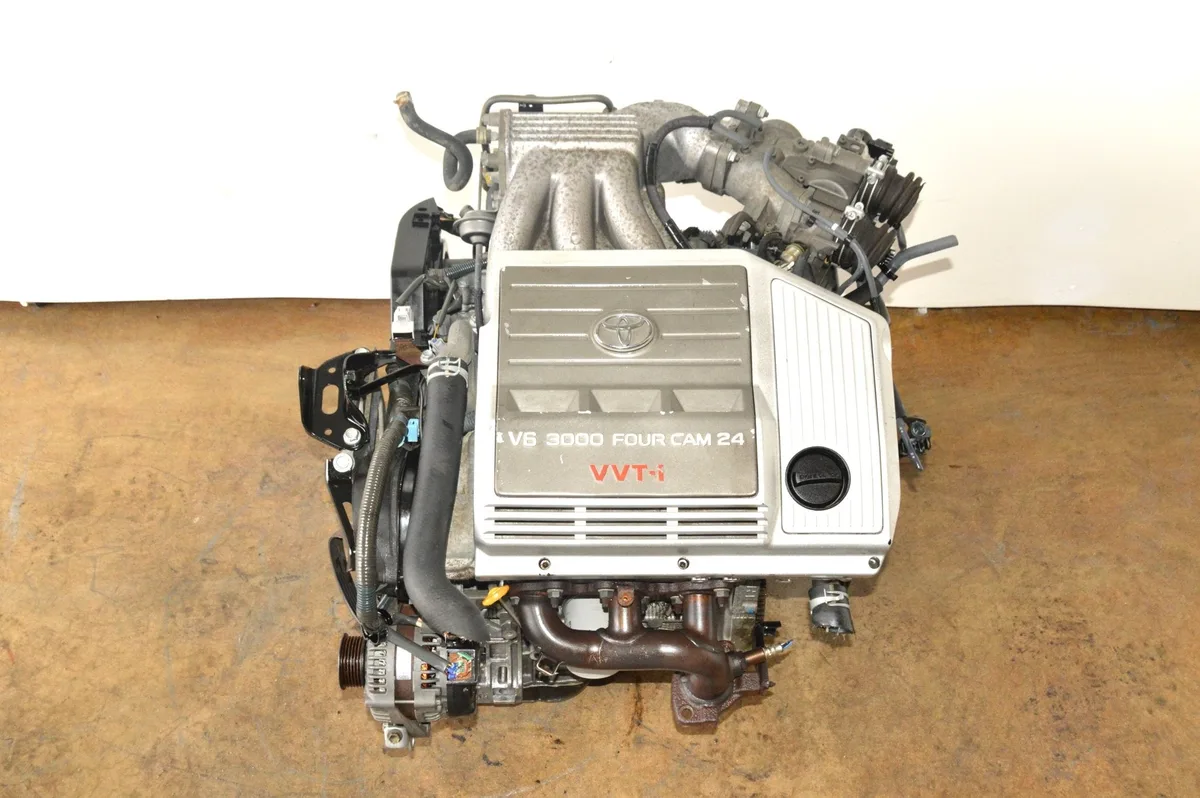
Image source: Web (Bing) / sanantoniojdmengines.com (Web image (fair-use with source credit))
Quick Answer: Oil Capacity at a Glance
If you're in a hurry, here's the direct answer.
- 2.4L 4-cylinder (2AZ-FE): 4.5 US quarts (4.3 liters) with a new filter
- 3.3L V6 (3MZ-FE): 5.5 US quarts (5.2 liters) with a new filter
Both engines use SAE 5W-30 oil. The recommended oil meets API SL or higher and ILSAC GF-4 or higher. As of 2026, most modern oils are marked API SN or SP.
These are backward-compatible and work perfectly.
One important note: those numbers assume you're changing the oil filter. If you skip the filter, subtract about 0.3 quarts. But just change the filter.
It costs a few dollars and takes five extra minutes.
Which Engine Is in Your 2005 Camry?
You need to know your engine before you buy oil. Here are three quick ways to check.
Method 1: Check the Under-Hood Emissions Label
Open the hood. Look for a white or yellow sticker on the underside of the hood, on the radiator support, or near the front of the engine bay. It's the Vehicle Emissions Control Information label.
It lists the engine displacement in liters. If it says "2.4L," you have the four-cylinder. If it says "3.3L," you have the V6.
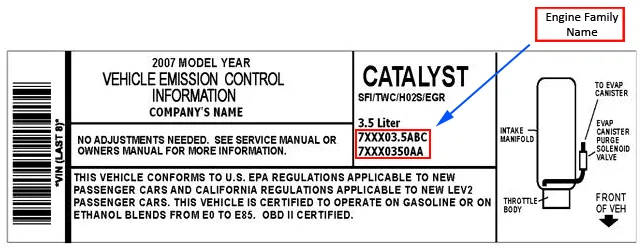
Image source: Web (Bing) / epa.gov (Web image (fair-use with source credit))
Method 2: Check the VIN
The 8th digit of your VIN tells you the engine. A "B" means the 2.4L four-cylinder. A "C" means the 3.3L V6.
You can find the VIN on the driver's side dashboard near the windshield or on the door jamb sticker.
Method 3: Look at the Engine
Pop the hood and look at the engine cover. The 2.4L has a plastic cover that says "VVT-i" and is smaller. The 3.3L V6 is larger and has two separate valve covers.
If you see six spark plug wires or six ignition coils, you have the V6.
Once you confirm your engine, you can buy the right amount of oil and the correct filter. Getting this step wrong is the most common mistake among 2005 Camry owners. The same approach applies if you're servicing a Camry from the same era.
The Right Oil: 5W-30 and Why It Matters
Toyota recommends 5W-30 for both engines. This comes from the owner's manual, the service manual, and the oil fill cap itself. Don't use 5W-20.
Don't use 10W-30 unless you're in a very hot climate and you've checked the manual's alternative recommendations.
Why 5W-30?
The "5W" means the oil flows like a 5-weight oil in cold weather. This helps with cold starts. The "30" means it thickens to a 30-weight oil at operating temperature.
This provides proper protection for these engines. The 2AZ-FE and 3MZ-FE were designed around this viscosity.
API Rating
Look for the API donut on the bottle. It should say API SL or higher. As of 2026, you'll find API SN and SP.
Both are backward-compatible and exceed the original spec. ILSAC GF-5 or GF-6 is also fine. The best oil for older Camry models follows these same standards.
Conventional vs. Synthetic
You can use either. Both engines were designed for conventional oil. But synthetic offers better protection in extreme temperatures.
It can also extend oil change intervals. Many owners report that synthetic keeps the engine cleaner over the long term, especially on high-mileage 2005 Camrys.
If you're on a budget, conventional is fine. Change it every 3,000 to 5,000 miles. If you want better protection, synthetic can go 5,000 to 7,500 miles.
The important thing is to change it regularly.
Step-by-Step: How to Do the Oil Change Right
Changing the oil on a 2005 Camry is straightforward. You can do it in under an hour with basic tools.
What You'll Need
- 4.5 quarts (4-cyl) or 5.5 quarts (V6) of 5W-30 oil
- A new oil filter (Toyota OEM 04152-YZZA1 or equivalent)
- A 14mm socket for the drain plug
- An oil filter wrench
- A drain pan (at least 6 quarts capacity)
- A funnel
- A new crush washer for the drain plug
- Jack stands and a floor jack
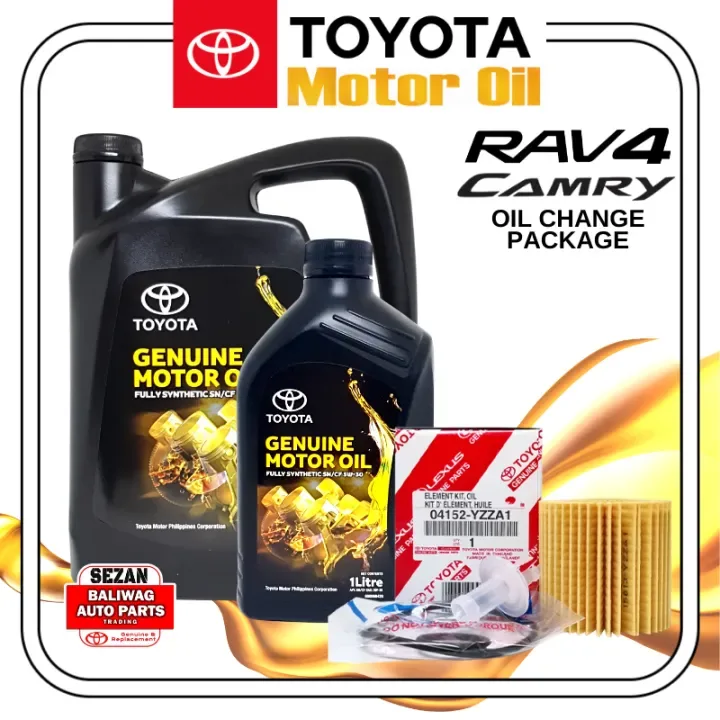
Image source: Web (Bing) / lazada.com.ph (Web image (fair-use with source credit))
Step 1: Drain the Old Oil
Warm up the engine for a few minutes. This thins the oil and helps it drain faster. Turn off the engine.
Raise the front of the car with a jack and secure it on jack stands. Never rely on a scissor jack alone.
Place your drain pan under the oil pan. Locate the 14mm drain plug. Remove it with a socket or wrench.
Let the oil drain completely. While it's draining, remove the old oil filter. It's on the front of the engine, right side.
Turn it counterclockwise with a filter wrench. Some oil will spill, so keep the drain pan underneath.
Step 2: Install the New Filter
Before installing the new filter, apply a thin coat of fresh oil to the rubber gasket. This prevents the gasket from sticking and ensures a proper seal. Screw the filter on by hand until it contacts the gasket.
Then tighten it another 3/4 turn by hand. Don't over-tighten it.
Step 3: Reinstall the Drain Plug
Clean the drain plug threads. Install a new crush washer if you have one. Torque the drain plug to 30 ft-lbs (40 Nm).
If you don't have a torque wrench, snug it up firmly with a ratchet. Don't over-torque it. The aluminum oil pan threads strip easily.
Step 4: Add the Oil
Lower the car. Remove the oil fill cap. Insert a funnel.
Add the appropriate amount.
- 4-cylinder: start with 4 quarts
- V6: start with 5 quarts
Put the cap back on. Start the engine and let it run for 30 seconds. This circulates the oil and fills the new filter.
Turn off the engine and wait 5 minutes for the oil to settle.
Step 5: Check the Dipstick
Pull the dipstick. Wipe it clean. Reinsert it.
Pull it again. Check the level. It should be between the low and high marks.
Add oil a quarter quart at a time until the level is at the full mark. Don't overfill. Overfilling causes foaming, which can damage the engine.
Check for leaks around the drain plug and filter. If everything looks good, you're done. Dispose of the old oil at a recycling center.
Auto parts stores accept it for free.
Common Mistakes That Can Cost You an Engine
These are the most frequent errors we see in our research. Avoid them.
Overfilling
Adding too much oil is worse than adding too little. Extra oil gets whipped into foam by the crankshaft. Foam doesn't lubricate well.
It can cause oil starvation and bearing damage. Stick to the exact capacity.
Underfilling
Putting in 4 quarts instead of 5.5 in a V6 leaves you a quart low. This can cause low oil pressure, especially during hard acceleration or on hills. Check the dipstick after every fill.
Using the Wrong Viscosity
5W-20 is too thin for these engines. It won't protect the bearings at operating temperature. 10W-30 is too thick for cold starts, especially in northern climates. Stick with 5W-30.
Forgetting the Crush Washer
The drain plug crush washer seals the plug to the oil pan. Reusing an old one can cause a slow leak. A new washer costs pennies at any auto parts store.
Not Priming the Filter
Some people install a dry filter. This means the engine runs without oil pressure for a few seconds on startup. Pre-fill the filter with fresh oil before installing it.
This provides immediate lubrication.
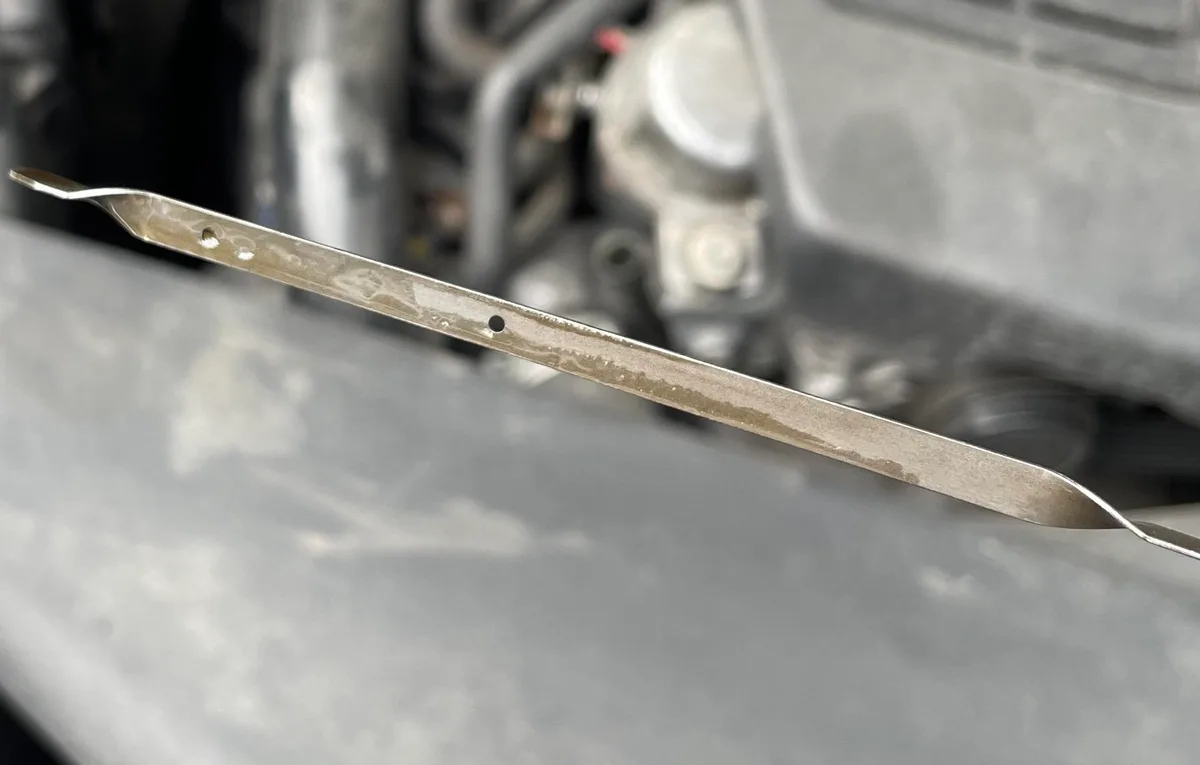
Image source: Web (Bing) / reddit.com (Web image (fair-use with source credit))
Conventional vs. Synthetic: What's Best for an Older Camry?
By 2026, your 2005 Camry is over 20 years old. The engine has some wear. Here's what the research and owner reports suggest.
Conventional Oil
- Cheaper. About $15 to $20 for a 5-quart jug.
- Works fine for most driving conditions.
- Needs changing every 3,000 to 5,000 miles.
- Good enough for low-mileage engines with no leaks.
Synthetic Oil
- Costs more. About $25 to $35 for a 5-quart jug.
- Handles high temperatures better.
- Resists sludge and deposits.
- Can extend intervals to 5,000 to 7,500 miles.
- Better for high-mileage engines with wear.
Our Take
If your Camry has over 100,000 miles, synthetic is worth the extra cost. It provides better protection for worn seals and bearings. If you're on a tight budget, conventional is still fine.
Just change it more often.
Oil Filter Options: OEM vs. Aftermarket
The oil filter matters as much as the oil. A cheap filter can bypass unfiltered oil into your engine.
Toyota OEM Filter
- Part number 04152-YZZA1 or 04152-31090
- Costs $8 to $12
- Built to exact Toyota specs
- Includes the correct o-ring and gasket
Aftermarket Filters
- Fram, Wix, Mobil 1, Bosch
- Cost $5 to $15
- Quality varies by brand
- Look for one with a silicone anti-drainback valve
Recommendation
Stick with OEM for peace of mind. The extra few dollars are worth it. If you go aftermarket, choose Wix or Mobil 1.
Avoid the cheapest no-name filters. Picking the right oil filter is just as important as choosing the oil itself.
Quick Reference: Specs at a Glance
Here's everything you need in one place.
| Spec | 2.4L 4-cylinder | 3.3L V6 |
|---|---|---|
| Oil capacity (with filter) | 4.5 US quarts | 5.5 US quarts |
| Oil viscosity | 5W-30 | 5W-30 |
| API rating | SL or higher | SL or higher |
| ILSAC rating | GF-4 or higher | GF-4 or higher |
| Oil filter part (OEM) | 04152-YZZA1 | 04152-YZZA1 |
| Drain plug torque | 30 ft-lbs | 30 ft-lbs |
| Filter torque | Hand-tight + 3/4 turn | Hand-tight + 3/4 turn |
Decision Guide: Your 60-Second Workflow
Follow this quick decision tree before every oil change.
Step 1: Identify your engine.
- Look at the under-hood label.
- Check the VIN 8th digit.
- Count the spark plugs.
Step 2: Buy the right oil.
- 5W-30 for both engines.
- Conventional or synthetic based on budget and mileage.
Step 3: Buy the right amount.
- 4.5 quarts for the 4-cylinder.
- 5.5 quarts for the V6.
Step 4: Buy the right filter.
- Toyota OEM 04152-YZZA1.
- Or a quality aftermarket brand.
Step 5: Do the change.
- Drain old oil.
- Replace filter.
- Refill with correct amount.
- Check dipstick.
Step 6: Recycle the old oil.
- Auto parts stores accept it for free.
- Never pour it down the drain.
That's it. You now know exactly what your 2005 Camry needs, how to identify your engine, and how to do the job right. The process is the same whether you're working on a sedan or looking after other Toyota models from the same era.
Proper maintenance keeps these cars running well past 200,000 miles.