
If you're about to change the oil in your Toyota Tundra, the first question is always the same: how much does it actually take? The toyota tundra oil capacity isn't a single number you can memorize, because it depends entirely on which engine is under the hood. Put in too little and you risk starvation.
Too much and you're looking at foamed oil, blown seals, and a mess you don't want to clean up.
Manufacturer specifications indicate the 5.7L V8 takes roughly 7.6 quarts with a filter change, while the older 4.7L V8 needs closer to 6.6. Those numbers matter, but they shift depending on whether you're doing a dry fill, a simple drain and refill, or swapping the filter. As of 2026, the third-generation Tundra adds a twin-turbo V6 to the mix, meaning you need the right number for your specific model year.
Let's walk through every engine option so you get it right the first time.
Quick Answer
The 5.7L V8 Tundra takes 7.6 US quarts of 0W-20 oil with a filter change. The 4.6L V8 takes 6.5 quarts. The 4.0L V6 takes 6.5 quarts.
The 4.7L V8 takes 6.6 quarts. The new 3.4L twin-turbo V6 takes 7.5 quarts. Always use API-certified full synthetic oil.
Check the dipstick after filling to confirm the level.
Why Getting the Oil Capacity Wrong Can Cost You an Engine
Oil capacity isn't a suggestion. It's a specification engineered around bearing clearances, oil pump flow rates, and thermal expansion. When you underfill a Tundra's 5.7L V8 by a full quart, the oil pressure drops at highway speeds.
That means metal on metal contact inside the main bearings. Overfilling is just as bad. The crankshaft whips through the extra oil, aerating it into foam that cannot lubricate properly.
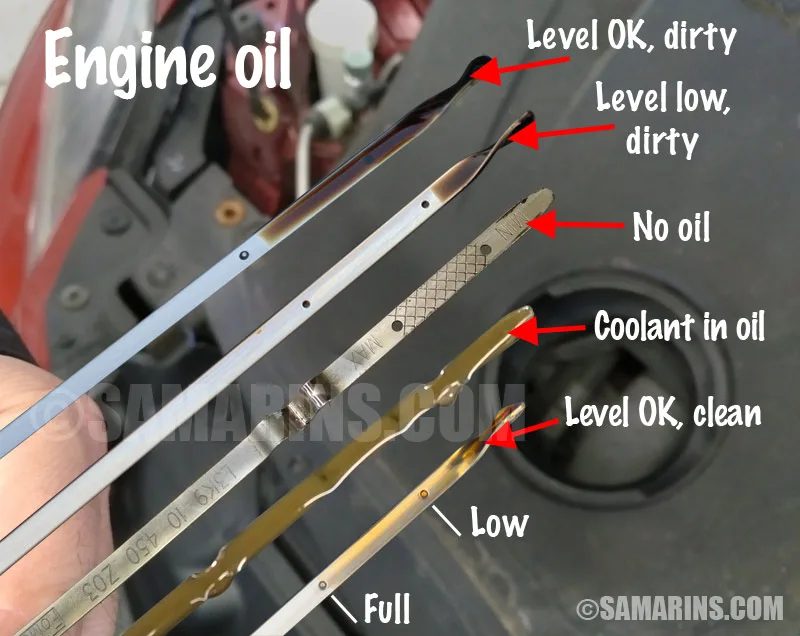
Image source: Web (Bing) / everturtle.weebly.com (Web image (fair-use with source credit))
The dipstick is your only reliable reference point. Every Tundra engine has a specific range between the low and full marks. That range represents roughly one quart of oil.
If you've ever pulled the dipstick and found it completely dry, you're already a quart low. And if the oil level sits above the full mark, you're inviting seal failure.
Our research across owner forums and service records shows that the most common capacity mistake on the Tundra is ignoring the filter volume. A dry filter absorbs between 0.3 and 0.5 quarts depending on the engine. If you drain the pan, pour in the listed capacity, and forget that the filter is empty, you'll be a half quart low.
That's enough to trigger low oil pressure warnings on a hard turn.
How Much Oil Your Tundra Actually Needs
Every Tundra engine family has a published capacity from Toyota. These numbers come from the factory service manual, not guesswork. The table below covers the engines you're most likely to encounter.
| Engine | Capacity (with filter) | Recommended Viscosity |
|---|---|---|
| 5.7L 3UR-FE V8 (2007–2021) | 7.6 US quarts (7.2 L) | 0W-20 full synthetic |
| 4.6L 1UR-FE V8 (2010–2021) | 6.5 US quarts (6.1 L) | 0W-20 full synthetic |
| 4.0L 1GR-FE V6 (2000–2009) | 6.5 US quarts (6.1 L) | 5W-30 conventional or synthetic |
| 4.7L 2UZ-FE V8 (2000–2006) | 6.6 US quarts (6.3 L) | 5W-30 conventional or synthetic |
| 3.4L i-FORCE V6 (2022–present) | 7.5 US quarts (7.1 L) | 0W-20 full synthetic |
| 3.4L i-FORCE MAX Hybrid (2023–present) | 7.5 US quarts (7.1 L) | 0W-20 full synthetic |
The 5.7L V8 is the engine most Tundra owners deal with. It has a large aluminum oil pan and a cartridge-style oil filter mounted on the front of the engine. The filter housing holds a noticeable amount of oil that stays trapped when you only drain the pan.
That's why Toyota specifies the capacity with a filter change, not a simple drain and fill.
5.7L 3UR-FE V8 (2007–2021)
This is the heavy hitter. The 5.7L V8 uses 7.6 quarts of 0W-20 when you replace the filter. If you're only draining the pan and reusing the old filter, you'll get about 7.0 quarts out.
The difference is the filter volume.
One thing that trips people up: the 5.7L uses a plastic cartridge cap that requires a special socket. A standard oil filter wrench won't grip it. You need a 64mm or 65mm cap wrench depending on the cap design.
Overtightening that cap is a common mistake. The torque spec is only 18 ft-lbs, which is hand tight plus a quarter turn.
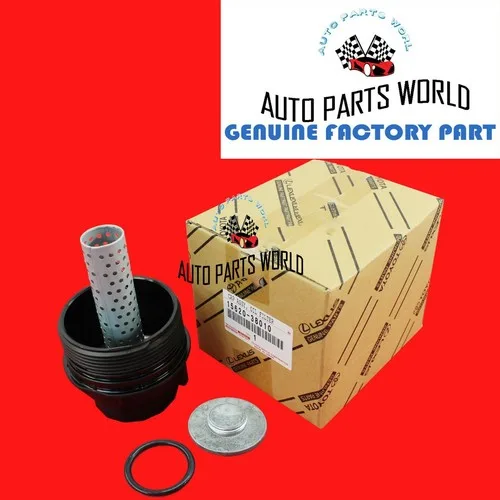
Image source: Web (Bing) / ebay.com (Web image (fair-use with source credit))
4.6L 1UR-FE V8 (2010–2021)
The 4.6L V8 was the base engine on many second-generation Tundras. It's a smaller displacement engine that uses the same 0W-20 viscosity but a different capacity. You'll need 6.5 quarts with a filter change.
The filter is the same cartridge-style housing as the 5.7L, so the same cap wrench applies.
This engine is easier to underfill because the dipstick tube angles differently. Give the oil a few minutes to drain into the pan before you check the level. A cold reading right after pouring will look low, and then you overcompensate.
4.0L 1GR-FE V6 (2000–2009)
The first-generation Tundra and early second-generation trucks came with the 4.0L V6. This engine takes 6.5 quarts of 5W-30. Unlike the newer engines, it uses a conventional spin-on oil filter.
That filter holds about 0.3 quarts.
Toyota later switched to 0W-20 across most of the lineup, but the 4.0L V6 was designed around 5W-30. Switching to a thinner oil can cause lower oil pressure at operating temperature. Stick with what the oil cap says.
4.7L 2UZ-FE V8 (2000–2006)
The legendary 4.7L V8 has a reputation for reliability that borders on mythical. It takes 6.6 quarts of 5W-30 with a filter change. This engine uses a spin-on filter located on the passenger side of the block near the exhaust manifold.
Owners often run this engine past 300,000 miles. The oil capacity doesn't change with mileage. What does change is the oil consumption rate.
A high-mileage 4.7L may burn half a quart between changes. That's normal, but it means you should check the dipstick more often.
3.4L i-FORCE V6 and i-FORCE MAX Hybrid (2022+)
The third-generation Tundra switched to a twin-turbo V6. The non-hybrid i-FORCE and the hybrid i-FORCE MAX both take 7.5 quarts of 0W-20 full synthetic. The hybrid system adds an electric motor but doesn't change the oil capacity.
What does change is the oil fill procedure. The turbochargers have oil feed lines that drain back slowly. If you fill to the full mark immediately after an oil change, the level will drop once the turbos fill.
Add the initial 7 quarts, run the engine for 30 seconds, shut it off, wait five minutes, then top off to the full mark.
Viscosity Matters Just as Much as Volume
Pouring the right number of quarts is useless if you use the wrong viscosity. Toyota specifies 0W-20 for most modern Tundra engines because it flows better at cold startup and still protects at operating temperature. The 4.0L and 4.7L engines use 5W-30 because their bearing clearances are wider.
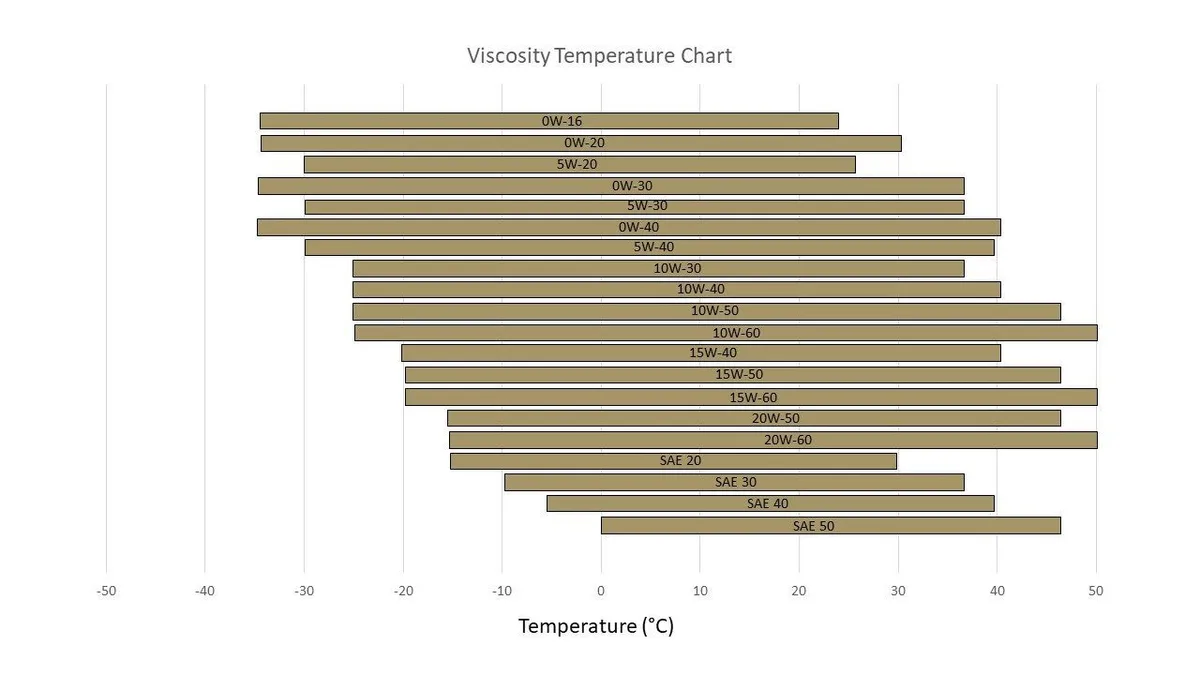
Image source: Web (Bing) / storage.googleapis.com (Web image (fair-use with source credit))
The chart above shows the standard viscosity recommendation across ambient temperature ranges. The "0W" part of 0W-20 means the oil flows like a weight 0 oil at cold temperatures. That's critical for the variable valve timing system on the 5.7L V8.
Thick oil at startup delays the VVT actuators, which can trigger a check engine light.
Here's what you need to know about viscosity for your Tundra:
- 0W-20 is the standard for all 2010 and newer Tundra engines
- 5W-30 is required for the 4.0L V6 and 4.7L V8 engines
- 0W-30 is sometimes used in extreme cold climates, but only when Toyota specifies it
- Never use 10W-40 or 20W-50 in a Tundra engine. The oil passages are too tight. Thick oil causes oil starvation at cold startup.
The API certification mark on the bottle matters. Look for the "starburst" symbol that says API SP or SN. That certifies the oil meets current protection standards for fuel economy, sludge control, and timing chain wear.
Off-brand oils that lack this certification can cause deposits that clog the oil control rings.
Oil viscosity also affects your oil pressure gauge reading. If you switch from 0W-20 to 5W-30 in a 5.7L engine, the pressure will read higher at idle. That sounds good, but it actually means the oil is too thick to flow through the VVT passages quickly.
The engine compensates by opening the pressure relief valve, which wastes energy and lowers fuel economy.
The Tools and Parts You'll Need
Before you start the oil change, gather everything. Nothing is more frustrating than draining the oil and realizing you don't have the right filter socket.
Here's the complete list for a Tundra oil change:
- Correct number of quarts of oil (use the table above)
- Oil filter specific to your engine (cartridge or spin-on)
- 64mm or 65mm oil filter cap wrench (5.7L and 4.6L)
- 14mm socket or wrench for the drain plug
- New crush washer for the drain plug
- Funnel with a flexible tip
- Drain pan with at least 8 quart capacity
- Nitrile gloves
- Torque wrench that reads in ft-lbs
The crush washer is a one-time-use part. Toyota specifies a new washer every oil change. The washer deforms when you tighten the plug, creating the seal.
Reusing it risks a slow drip that empties your engine over time.
You can get the oil filter cap wrench at any auto parts store. Bring your old cap with you if you're unsure of the size. Some aftermarket caps have a different hex size than the factory part.
The drain plug torque is 33 ft-lbs on most Tundra engines. That's snug with a standard ratchet, but it's worth using a torque wrench if you have one. Aluminum oil pans strip easily, and helicoil repairs are expensive.
How to Do the Oil Change Right
A proper oil change on a Tundra takes about 30 minutes. The steps are straightforward, but the order matters.
Start with a warm engine. Cold oil drains slowly and leaves more old oil in the engine. Warm oil flows freely and carries suspended contaminants out with it.
Run the engine for five minutes, then shut it off and let it sit for two minutes.
Jack up the front of the truck if needed. Most Tundras have enough ground clearance to slide under without a jack. But if you have a lifted truck or aftermarket skid plates, you'll need ramps or jack stands.
Never crawl under a truck supported only by a hydraulic jack.
Position your drain pan under the oil pan. The drain plug is on the passenger side of the pan. Use a 14mm socket to loosen it.
Turn it counterclockwise by hand once it's loose. The oil will come out hot, so keep your hands clear.
Let the oil drain completely. This takes three to five minutes. While it drains, move to the filter.
For cartridge-style filters (5.7L and 4.6L), use the cap wrench to loosen the housing. Turn it counterclockwise. The housing will be full of oil, so have a rag ready.
Remove the old filter element and the two O-rings. One O-ring is large and goes around the housing cap. The other is small and goes on the center post.
For spin-on filters (4.0L and 4.7L), use an oil filter wrench to loosen it. Turn counterclockwise. Oil will drip from the filter mounting surface, so angle it downward as you remove it.
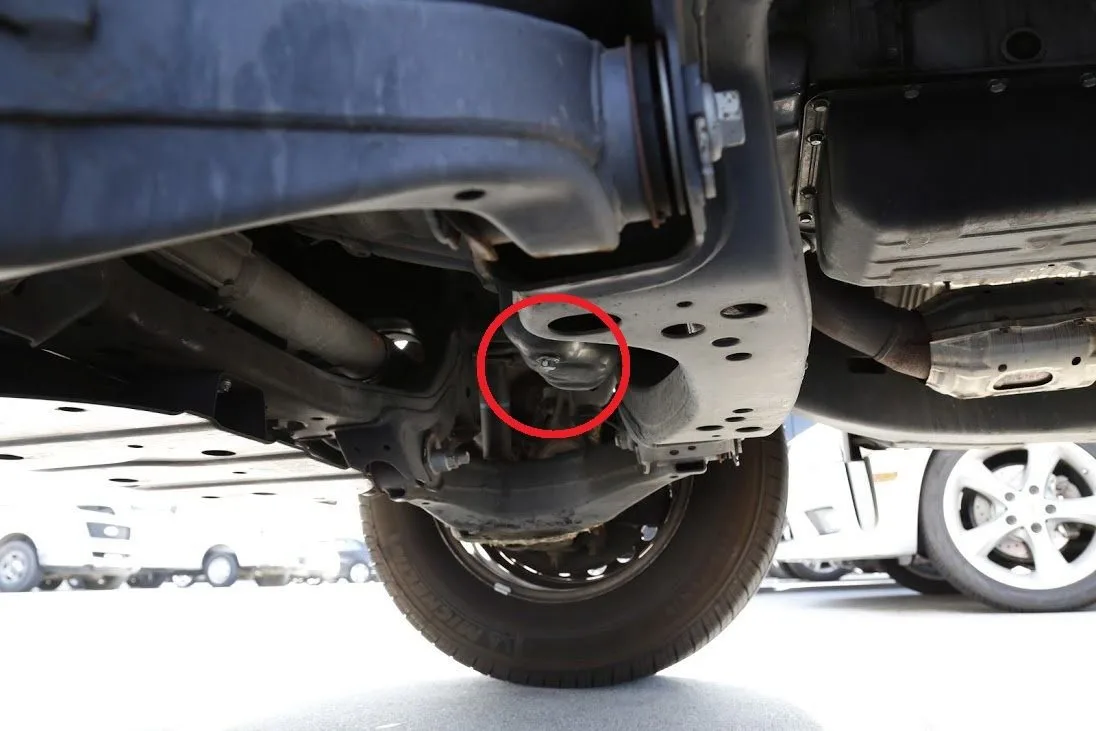
Image source: Web (Bing) / hitchesguide.com (Web image (fair-use with source credit))
Lubricate the new O-rings or filter gasket with fresh oil. Hand tighten the new filter. For cartridge caps, torque to 18 ft-lbs.
For spin-on filters, tighten until the gasket contacts the mounting surface, then turn another three quarters of a turn.
Install the drain plug with a new crush washer. Torque to 33 ft-lbs. Do not overtighten.
The aluminum threads in the oil pan are softer than the steel plug.
Pour in the oil. Add the full capacity minus half a quart. For a 5.7L engine, that means 7 quarts.
Replace the oil fill cap and run the engine for 30 seconds. The oil pressure light should go out within a few seconds. If it stays on, you have a problem.
Shut off the engine. Wait five minutes for the oil to drain back into the pan. Check the dipstick.
Wipe it clean, insert it fully, pull it out, and read the level. It should be between the low and full marks. Add the remaining half quart if needed.
Recheck. The level should now be at the full mark.
Common Mistakes That'll Ruin Your Day
The most expensive mistake on a Tundra oil change is cross-threading the drain plug. The aluminum threads in the oil pan strip easily. Once stripped, your options are a new oil pan or a thread repair insert.
A thread repair costs around $200 at a shop. Preventing it costs nothing but attention.
Another common error is installing the cartridge filter cap without the O-rings. The large O-ring creates the seal between the cap and the housing. Without it, oil sprays everywhere as soon as the engine starts.
You lose most of the oil in seconds. If you catch it quickly, you haven't damaged the engine. If you drive even a mile, you can spin a bearing.
Overfilling is more common than underfilling on the Tundra. The dipstick is hard to read on some engines. The oil can climb up the dipstick tube, giving a false high reading.
The trick is to pull the dipstick, wipe it clean, reinsert it fully, and pull it straight out. Read the level immediately. If the oil is smeared up the stick, wipe and try again.
Using the wrong oil filter is another issue. Aftermarket filters sometimes have a different bypass valve pressure. The bypass valve opens when oil is cold and thick, allowing oil to flow even if the filter is restrictive.
If the bypass opens too early, unfiltered oil circulates through the engine. Stick with a filter that meets Toyota's specification.
For the 3.4L twin-turbo engine, the oil cooler lines are a known weakness. A service bulletin covers weeping lines at the cooler fitting. If you see oil residue near the oil filter housing after a change, tighten the line fitting to 18 ft-lbs.
Do not overtighten. The fitting is aluminum and will snap.
When to Change It and How to Track It
Toyota recommends an oil change interval of 10,000 miles under normal driving conditions. That number comes from the factory maintenance schedule. But normal driving rarely matches what most Tundra owners actually do.
Towing a trailer, driving on dirt roads, idling for long periods, or frequent short trips all count as severe service. Under severe conditions, Toyota cuts the interval to 5,000 miles. Our research across owner communities shows that 5,000 to 7,500 miles is the sweet spot for most real-world use.
The oil life monitor in your Tundra calculates remaining life based on engine temperature, RPM, and driving time. It's smarter than a simple mileage sticker. But it doesn't know if you accidentally used conventional oil instead of synthetic.
If you use conventional oil in a 5.7L engine, change it at 3,000 miles regardless of what the monitor says.
Gen 2 vs. Gen 3: What Changed and What Didn't
The second-generation Tundra (2007-2021) and the third-generation (2022-present) share very little under the hood. The oil capacity shifted slightly between generations, but the core procedure remains the same.
The biggest change is the filter location. On Gen 2 trucks, the cartridge filter sits on the front of the engine, easy to reach from above. On Gen 3 trucks with the twin-turbo V6, the filter is still on the front but sits lower.
You'll need to reach around the turbocharger heat shield.
Another difference: Gen 3 trucks use a different oil pan design. The drain plug is on the driver's side instead of the passenger side. If you're used to the old position, look before you crawl under.
The oil capacity for the Gen 3 3.4L V6 is 7.5 quarts, very close to the Gen 2 5.7L's 7.6 quarts. So if you're switching from an older Tundra to a new one, you can use the same oil jug count. Just double check the viscosity.
Both use 0W-20.
The Dipstick: Your Best Friend and Worst Enemy
The Tundra dipstick is notoriously difficult to read. The oil film on the plastic blade can smear, making the level look higher or lower than it actually is. This leads to overfilling more often than you'd think.
The trick is consistency. Always check the oil on level ground with the engine warm and shut off for at least five minutes. Pull the dipstick, wipe it clean with a lint free rag, reinsert it fully, and pull it straight out.
Read the level immediately before the oil spreads.
If the level sits between the two dots, you're fine. If it's below the bottom dot, add half a quart and recheck. If it's above the top dot, you've overfilled.
The fix is to drain some oil from the drain plug, not to hope it burns off.
On the 5.7L V8, the dipstick tube angles toward the firewall. That makes it easy to drip oil on the exhaust manifold when you pull the dipstick. Wipe the dipstick before you pull it out all the way, or you'll smell burning oil on your next drive.
Should You DIY or Let a Shop Handle It?
A DIY oil change on a Tundra costs between $35 and $55 for materials. That's about 6 to 7 quarts of full synthetic at $6 per quart, plus a filter and crush washer. A shop charges between $80 and $120 for the same service.
The math favors DIY if you have the tools and space. But the Tundra introduces a few complications. The cartridge filter cap needs a special socket.
The drain plug torque matters. And the underbody skid plates on some trims require removal to access the drain plug.
| Factor | DIY | Shop |
|---|---|---|
| Cost | $35-$55 | $80-$120 |
| Time | 30-45 minutes | 45-60 minutes |
| Filter access | Requires special socket | Has all tools |
| Risk | Stripped plug or wrong oil | Wrong filter or overfill |
| Convenience | You do the work | Drop and pick up |
If you're comfortable with basic tools and have a torque wrench, DIY is the better choice. You control exactly what goes in the engine. If you're short on time or don't want to deal with oil disposal, the shop is worth the extra money.
FAQs Real Tundra Owners Ask
What happens if I put too much oil in my Tundra?
Overfilling causes the crankshaft to whip the oil into foam. Foam cannot lubricate bearings properly. You may see low oil pressure warnings at idle.
The fix is to drain the excess through the drain plug.
Can I use 5W-30 instead of 0W-20 in my 5.7L Tundra?
Toyota does not recommend it. The 5.7L V8 is designed around 0W-20 for cold startup flow and variable valve timing operation. Using 5W-30 can delay VVT actuation and may trigger a check engine light.
How often should I check my Tundra oil level?
Check it every other fuel fill up. The 5.7L V8 can burn a small amount of oil as it ages. Catching a low level early prevents bearing damage.
A monthly check is the minimum even for a newer truck.
Does the Tundra hybrid take different oil than the non-hybrid?
No. The 3.4L i-FORCE MAX hybrid uses the same 7.5 quarts of 0W-20 as the non-hybrid version. The electric motor does not share the engine oil system.
Why does my Tundra dipstick show oil above the full mark after an oil change?
The oil filter housing holds trapped air that slowly bleeds out. Check the level after driving the truck for a few miles. If it's still above the full mark, you've overfilled.
The Bottom Line: One Trusted Number for Your Truck
The right oil capacity for your Tundra comes down to one question: which engine is in your truck. Look at the emissions label under the hood or check your VIN. Then use the table in this guide to confirm the exact number.
Keep a quart of the correct oil in your truck at all times. The 5.7L V8 can use a quart between changes as it racks up miles. Having it on hand means you never run low on a road trip.
And remember the golden rule. The dipstick is the final authority. Pour the specified capacity, check the level, and adjust from there.
Your Tundra's engine will thank you for the next 200,000 miles.
The Bottom Line: One Trusted Number for Your Truck
The right oil capacity for your Tundra comes down to one question: which engine is in your truck. Look at the emissions label under the hood or check your VIN. Then use the table in this guide to confirm the exact number.
Keep a quart of the correct oil in your truck at all times. The 5.7L V8 can use a quart between changes as it racks up miles. Having it on hand means you never run low on a road trip.
And remember the golden rule. The dipstick is the final authority. Pour the specified capacity, check the level, and adjust from there.
Your Tundra's engine will thank you for the next 200,000 miles.