
Image source: Web (Bing) / detroitchinatown.org (Web image (fair-use with source credit))
If you own a 2003 Toyota Corolla, you've probably wondered what oil to put in it. Maybe you're doing your first DIY oil change. Maybe your mechanic suggested something that didn't sound right.
Or maybe you just bought this car used and want to keep it running for another hundred thousand miles.
The short answer is straightforward. Your 2003 Corolla needs SAE 5W-30 motor oil with an API SL rating or higher. That's what the owner's manual says.
That's what the 1ZZ-FE engine in this car was designed to use. As of 2026, these cars are over two decades old. Using the wrong oil can quietly destroy an engine that's already past its prime.
Quick Answer
Your 2003 Corolla needs SAE 5W-30 motor oil. The API rating should be SL or higher. ILSAC GF-3 or higher.
Total capacity is 3.8 quarts with a filter change. Use conventional, synthetic blend, or full synthetic. Pick one that meets those specs.
Why Getting the Right Oil Matters for Your 2003 Corolla
This isn't a "close enough" situation. The 1ZZ-FE engine in your Corolla was designed with tight internal clearances. Those clearances were engineered around a specific oil viscosity.
Change that viscosity and you change how the engine behaves.
Use oil that's too thick and it won't flow properly on cold starts. The engine parts won't get lubricated quickly. That means metal-on-metal contact during the most vulnerable moments of every drive.
Do that for a few winters and your bearings will let you know.
Use oil that's too thin and it won't maintain a protective film at operating temperature. The oil shears down under heat and pressure. Moving parts start touching.
Heat builds. Eventually something gives.
The 1ZZ-FE also has a known tendency to burn oil as it ages. That's a separate issue we'll cover later. But the right oil can slow that down.
The wrong oil makes it worse.
The 1ZZ-FE Engine: Why This Matters More Than You Think
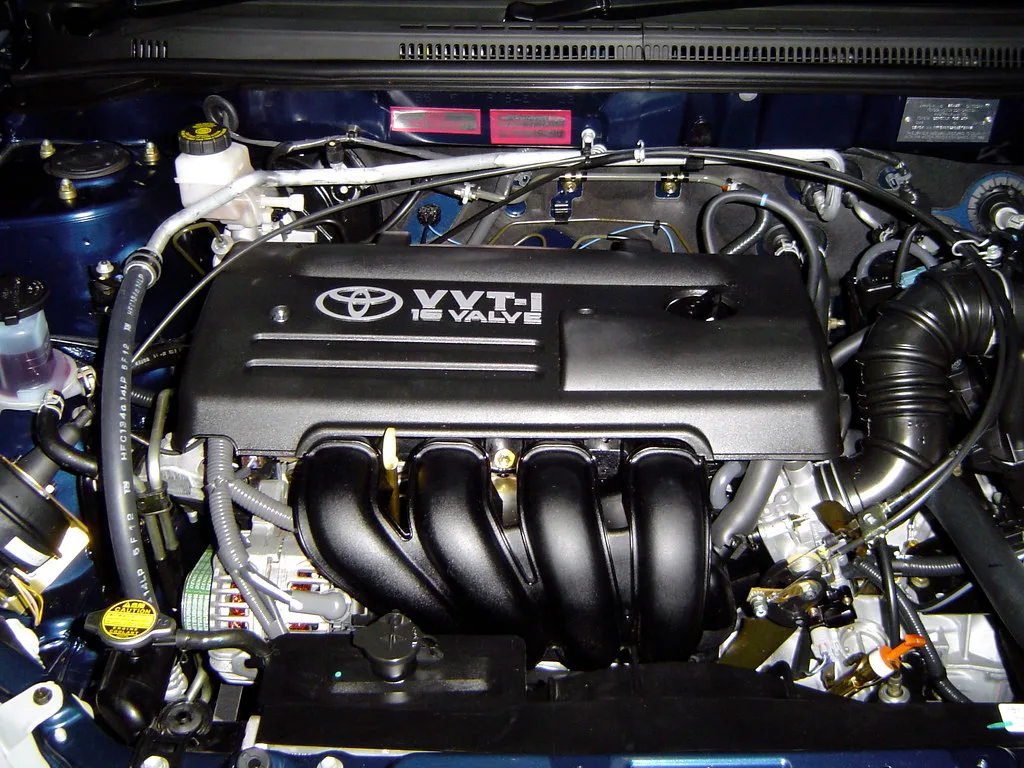
Image source: Web (Bing) / flickr.com (Web image (fair-use with source credit))
The 1ZZ-FE is a 1.8-liter four-cylinder engine Toyota produced from 1998 through 2004. It powered the Corolla, the Celica, and the Matrix. It's a reliable engine when maintained properly.
But it has quirks.
One quirk is oil consumption. Toyota even issued a technical service bulletin about it. The piston rings on some 1ZZ-FE engines don't seal as well as they should.
Oil gets past them into the combustion chamber. You burn oil. You add oil.
Repeat.
This doesn't mean your engine is dying. It means you need to stay on top of the oil level and use the right formulation. High-mileage oils contain seal conditioners that help reduce this consumption.
Another quirk is sludge vulnerability. The 1ZZ-FE runs hot and has narrow oil passages. If you skip oil changes or use cheap oil that breaks down quickly, sludge builds up inside.
Sludge blocks those passages. Starved bearings fail. The engine seizes.
Viscosity Explained: Why 5W-30 Is the Standard
Let's decode what those numbers mean so you never have to guess again.
Oil viscosity is simply how thick or thin the oil is. Thicker oil flows slower. Thinner oil flows faster.
But engine oil has to do two contradictory things. It has to flow quickly when cold so it reaches every part before the engine starts moving. And it has to stay thick enough when hot to keep a protective film between moving parts.
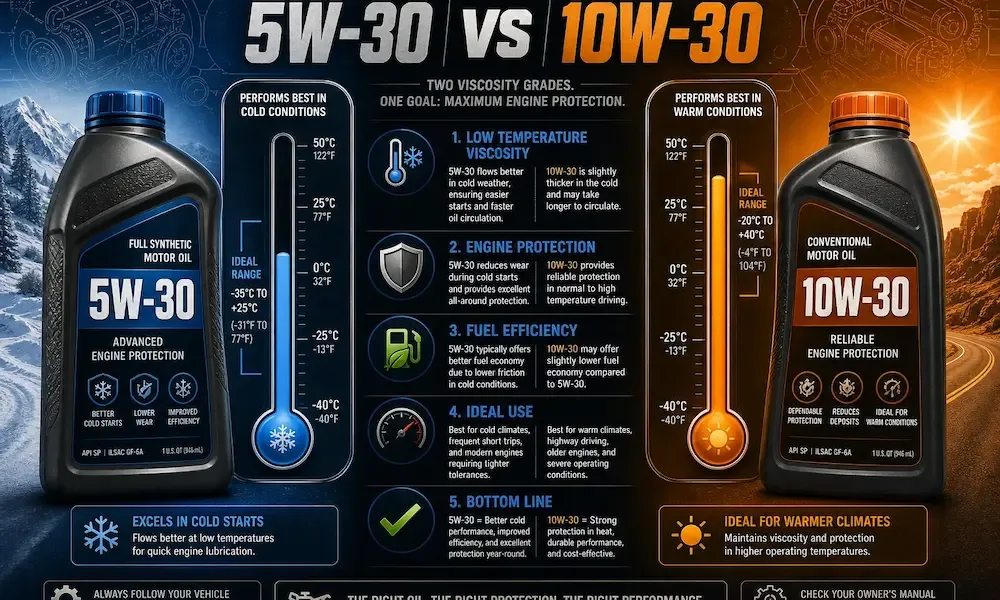
Image source: Bing (Web (fair-use with source credit))
That's why we use multi-viscosity oils. The "5W" part tells you how the oil behaves in winter. The "30" tells you how it behaves at normal engine operating temperature.
5W-30 means the oil flows like a 5-weight oil when cold. That's thin. That's good for cold starts.
At operating temperature it behaves like a 30-weight oil. That's thick enough to protect bearings and cylinder walls.
Some people think using 10W-30 is better for older engines. They think thicker oil fills worn gaps. That's not how it works.
The 1ZZ-FE's oil pump was designed for 5W-30. Thicker oil puts more stress on the pump. It flows slower through those narrow passages.
It doesn't reach the top end of the engine as quickly on cold mornings.
The only situation where 10W-30 makes sense is if you live in a consistently hot climate and never see cold starts. Even then, Toyota still specifies 5W-30 as the preferred grade. The owner's manual lists 10W-30 as acceptable only above 0°F.
Conventional vs. Synthetic vs. High-Mileage: What Should You Use?
This is the question that trips people up the most. Let's break it down simply.
| Oil Type | Best For | Cost per Change (DIY) | Change Interval |
|---|---|---|---|
| Conventional | Low mileage engines, tight budgets | $18 – $25 | 3,000 – 4,000 miles |
| Synthetic Blend | Daily drivers, moderate mileage | $25 – $35 | 4,000 – 5,000 miles |
| Full Synthetic | High mileage engines, extreme temperatures | $35 – $50 | 5,000 – 7,500 miles |
| High-Mileage Synthetic | Engines over 75,000 miles with oil consumption | $30 – $45 | 4,000 – 5,000 miles |
Conventional oil is fine if your Corolla has under 100,000 miles and doesn't burn oil. Change it every 3,000 to 4,000 miles. It's the cheapest option.
But it breaks down faster than synthetic. You have to stay disciplined with the change interval.
Full synthetic offers better protection across the board. It handles high temperatures without breaking down. It flows better in extreme cold.
It resists sludge formation. For a 2003 Corolla that you want to keep on the road for years, it's the smartest choice. The extra cost per change is small compared to the cost of an engine.
High-mileage oil deserves special attention here. These formulations include seal conditioners that help soften and expand aged rubber seals. On a 1ZZ-FE with over 150,000 miles, these conditioners can reduce the oil burning problem.
They also contain higher levels of detergents that clean out existing sludge. High-mileage synthetic is the most recommended option among experienced Corolla owners for cars past the 125,000-mile mark.
Synthetic blend sits in the middle. It's conventional oil with some synthetic base stock mixed in. It offers slightly better protection than straight conventional at a slightly lower price than full synthetic.
It's a reasonable compromise if you're on a budget.
Whichever you pick, make sure it has the API donut on the back of the bottle. Look for the API SL, SM, or SN rating. SN is the newest and offers the best protection for older engines.
SN Plus and SP are fine too. They're backward compatible.
The Real Cost of Using the Wrong Oil
Let's put some numbers on this. A quart of the right 5W-30 costs about six to eight dollars. A replacement engine for a 2003 Corolla runs anywhere from 1,500 to 3,000 dollars installed.
That's if you can find a good used one.
The math is pretty simple.
Using 10W-40 because "it's older and needs thicker oil" is a common mistake. That thicker oil doesn't flow through the 1ZZ-FE's variable valve timing system properly. The VVT actuators clog.
You get a check engine light and timing codes. Fixing that costs hundreds.
The same goes for using cheap off-brand oil that doesn't meet API standards. It breaks down faster. It forms sludge.
That sludge blocks the oil pickup tube. The engine starves. The bearings spin.
The whole thing seizes on the highway.
We've seen this pattern in mechanic shops for years. Someone tries to save twenty bucks per oil change. Three years later they're shopping for a used motor.
The right oil every 4,000 to 5,000 miles will cost you about 75 dollars per year in materials. That's a bargain.
Step-by-Step: How to Change the Oil Yourself
This job takes about 30 minutes the first time. Faster after that. Here's what you'll need:
- 5W-30 oil, 4 quarts (you'll use 3.8)
- Oil filter
- 19mm socket or wrench for the drain plug
- Oil filter wrench
- Drain pan
- Funnel
- Crush washer
Step 1: Warm up the engine. Run it for two or three minutes. Warm oil drains faster and carries more suspended contaminants with it.
Step 2: Get under the car and locate the drain plug. It's on the passenger side of the oil pan, facing the rear. Place your drain pan underneath.
Step 3: Remove the drain plug. Turn it counterclockwise with your 19mm socket. Let it drain completely, about five minutes.
Step 4: Replace the crush washer. This is a small copper or aluminum ring that seals the drain plug. Always use a new one. A reused crush washer can leak.
Step 5: Reinstall the drain plug. Torque it to 29 foot-pounds. If you don't have a torque wrench, snug it up and give it another quarter turn. Do not overtighten.
Step 6: Remove the old oil filter. It's on the front of the engine, just behind the radiator. Turn it counterclockwise. Have rags ready.
Step 7: Prep the new filter. Rub a thin layer of fresh oil on the rubber gasket. This prevents the gasket from sticking. Screw it on hand-tight, then give it another three-quarter turn.
Step 8: Add the new oil. Remove the oil fill cap on top of the valve cover. Insert your funnel. Pour in about 3.5 quarts.
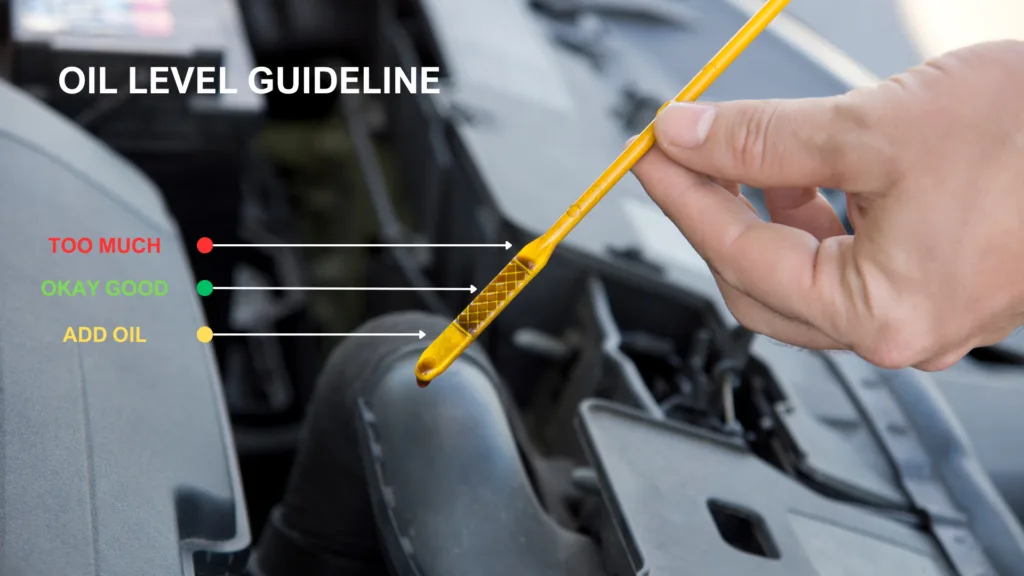
Check the dipstick. Add more until it reads between the two marks.
Step 9: Check for leaks. Start the engine. Let it run for 30 seconds. Shut it off.
Look under the car for drips from the drain plug and filter.
Step 10: Dispose of the old oil. Pour it back into the empty oil bottles. Most auto parts stores accept used oil for free. Never dump it on the ground or in the trash.
Common Mistakes Even Experienced DIYers Make
Overtightening the filter. The oil filter gasket is a rubber ring. Crank it too hard and the gasket distorts. It either leaks or tears.
Hand-tight plus three-quarter turn is enough.
Skipping the crush washer. The drain plug crush washer deforms when you tighten it. That deformation creates the seal. Reuse it and you're relying on metal-on-metal contact.
It will eventually drip. A pack of ten crush washers costs three dollars.
Using the wrong viscosity. The 1ZZ-FE wants 5W-30. Not 5W-20. Not 10W-40.
Not 0W-20. The oil pump and internal clearances were designed around 5W-30. Trust the engineers.
Overfilling. Adding too much oil is almost as bad as too little. The crankshaft whips the excess oil into foam. Foam doesn't lubricate.
Check your dipstick three times before calling it done.
Ignoring the PCV valve. This little valve costs about ten dollars. It regulates crankcase pressure. When it clogs, pressure builds up and forces oil past seals and rings.
Replace it every 60,000 miles.
When to Use 10W-30 Instead of 5W-30
The owner's manual for the 2003 Corolla lists 5W-30 as the preferred viscosity. But it also says 10W-30 is acceptable. The question is when.
Use 10W-30 if you live in a climate where temperatures never drop below freezing. That means places like southern Texas, Florida, or coastal California. In those conditions, the cold-start advantage of 5W-30 matters less.
Do not use 10W-30 if you experience winter temperatures below 32°F. The oil will be too thick at startup. It won't reach the top end of the engine quickly enough.
That causes accelerated wear on the valve train.
There's no performance benefit to running 10W-30 in a healthy 1ZZ-FE. The engine doesn't run hotter. It doesn't make more power.
The thicker oil just puts more drag on rotating parts and reduces fuel economy slightly.
If your engine has over 200,000 miles and burns a quart every 1,000 miles, some mechanics recommend trying 10W-30. The theory is that thicker oil fills worn ring gaps better. Results are mixed.
Some owners report reduced consumption. Others see no change. The safer bet is high-mileage 5W-30 with seal conditioners.
Oil Consumption: Why Your Corolla Might Be Burning Oil
This is the most discussed issue among 1ZZ-FE owners. The engine burns oil. It's not a defect.
It's a design characteristic that becomes more pronounced with age.
The root cause is the piston ring design. Toyota used low-tension rings on the 1ZZ-FE to reduce friction and improve fuel economy. The trade-off is that the rings don't seal as tightly against the cylinder walls.
Over time, the ring gaps grow. Oil slips past into the combustion chamber. You see blue smoke on startup or under hard acceleration.
Here's what to do about it:
Check your oil level every other fill-up. This is non-negotiable for a 2003 Corolla with over 100,000 miles. Pop the hood. Pull the dipstick.
Wipe it. Dip it again. Read it.
Add if needed.
Use high-mileage oil. These formulations contain seal swellers that soften and expand aged rubber valve stem seals. They also have polymer additives that improve ring seal. Many owners report cutting oil consumption in half after switching to high-mileage 5W-30.
Replace the PCV valve. A stuck-closed PCV valve creates positive crankcase pressure. That pressure pushes oil past seals and rings. It's a ten-dollar part that takes two minutes to change.
Consider switching to 5W-40. This is a last resort. Some high-mileage 1ZZ-FE engines respond well to a slightly thicker hot viscosity. 5W-40 flows like 5W-30 when cold but acts like a 40-weight at operating temperature. It can help with consumption.
But it also increases engine drag and may reduce fuel economy. Try high-mileage 5W-30 first.
If your Corolla is burning more than a quart every 500 miles, the rings or valve seals are likely worn beyond what oil additives can fix. At that point, a rebuild or replacement engine is the realistic solution.
How Often Should You Change the Oil?
This depends on the oil you use and how you drive. Conventional oil needs changing every 3,000 to 4,000 miles. Synthetic blends stretch to 4,000 to 5,000 miles.
Full synthetic can go 5,000 to 7,500 miles.
But here's the catch. A 2003 Corolla with over 150,000 miles is not a new car. It burns some oil.
It has wear. Short trips where the engine never fully warms up contaminate the oil faster. So does stop-and-go traffic.
If you mostly drive short trips under five miles, change the oil more often. Stick to 3,000 miles regardless of what the bottle says. The fuel dilution and moisture buildup from cold operation breaks down oil quickly.
For highway driving with longer trips, you can extend the interval. Full synthetic at 5,000 to 6,000 miles is safe for these engines. Just check the dipstick every second fill-up.
One hard rule. Never go past 7,500 miles. The 1ZZ-FE is susceptible to sludge.
Extended intervals encourage it. A 25 dollar oil change is cheap insurance against a 2,000 dollar engine.
The Oil Filter: Why It's Not Optional
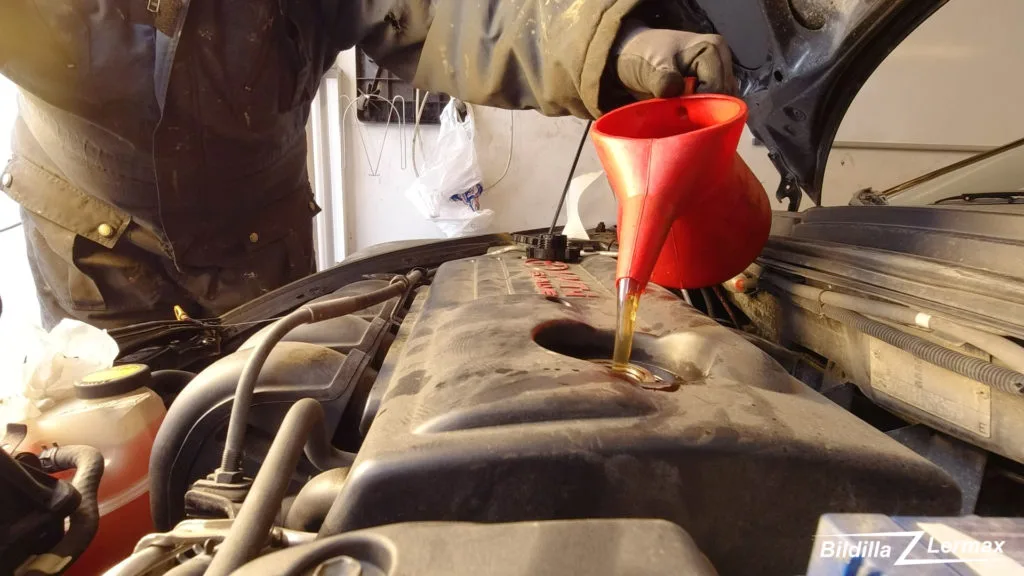
Image source: Web (Bing) / bildillamagasin.no (Web image (fair-use with source credit))
The oil filter is not a place to save two dollars. A cheap filter uses cardboard end caps and paper media that collapses under pressure. When it collapses, unfiltered oil circulates through the engine.
Debris scores bearings and cylinder walls.
Your 2003 Corolla uses a spin-on filter with a 3/4-16 thread. The factory spec filter has a bypass valve setting around 8 to 11 psi. That bypass valve matters.
It opens when the filter clogs so the engine still gets oil.
Cheap filters sometimes have incorrect bypass pressures. Too high and the filter starves the engine. Too low and unfiltered oil bypasses the filter media all the time.
Stick with a known brand. The OEM Toyota filter works perfectly. Wix and Mobil 1 make excellent replacements.
Fram has mixed reviews among Corolla owners. If you use Fram, get the Ultra or tough guard line. Skip the basic orange can.
Change the filter with every oil change. No exceptions.
Expert Tips for Keeping That 1ZZ-FE Alive Past 200,000 Miles
Warm up before driving hard. The 1ZZ-FE needs about 30 seconds of idle after a cold start. That's enough to circulate oil everywhere. Then drive gently until the temperature gauge reaches normal.
Full throttle before the oil is warm accelerates wear dramatically.
Replace the PCV valve every 60,000 miles. It costs ten dollars. It takes two minutes. A stuck PCV valve causes oil consumption and sludge.
This is the most overlooked maintenance item on this engine.
Use a quality oil filter. We covered this above. It matters.
Check the valve cover gasket. On high mileage 1ZZ-FE engines, the valve cover gasket hardens and leaks. Oil drips onto the exhaust manifold. It smells bad.
It also means you're losing oil you can't measure on the dipstick. Replace the gasket when you notice oil on the side of the engine block.
Don't ignore the coolant. The 1ZZ-FE runs hot. Sludge formation accelerates when the engine overheats. Keep the cooling system healthy.
Replace the coolant every 60,000 miles. Check for leaks from the water pump and radiator.
Stick with 5W-30 high-mileage synthetic. It's the single best thing you can do for an aging Corolla. The seal conditioners reduce oil consumption. The detergents keep internal passages clean.
The thermal stability prevents breakdown.
Frequently Asked Questions
Can I use 5W-20 in my 2003 Corolla?
No. Toyota does not recommend 5W-20 for the 1ZZ-FE engine. It is too thin at operating temperature.
It won't maintain adequate film strength. Stick with 5W-30.
How much oil does a 2003 Corolla need?
The total capacity is 3.8 quarts with a filter change. Buy a 5 quart jug. You'll use most of it.
Keep the leftover for topping off between changes.
What happens if I use 10W-40 in my Corolla?
The oil will be too thick when cold. It won't flow through the VVT system properly. You may get timing codes and reduced performance.
Fuel economy will drop. Long term, it strains the oil pump.
Is synthetic oil worth it for an older Corolla?
Yes. Full synthetic flows better at cold starts. It resists sludge formation.
It handles high temperatures without breaking down. For a 20 year old engine with tight clearances, synthetic offers measurably better protection.
Why does my 2003 Corolla burn oil?
The 1ZZ-FE uses low-tension piston rings. They reduce friction but don't seal as tightly. Over time, ring gaps widen.
Oil slips past into the combustion chamber. High-mileage oil with seal conditioners helps. So does replacing the PCV valve.
Can I switch from conventional to synthetic on a high-mileage engine?
Yes. This is a common myth. Switching to synthetic will not cause leaks.
If the engine already leaks, synthetic's better detergents may clean out old deposits that were temporarily plugging a gap. Fix the leak. Then enjoy the better protection.
Final Verdict: What to Put in Your 2003 Corolla
Use SAE 5W-30 motor oil with an API SL rating or higher. High-mileage synthetic is the smartest choice for any 1ZZ-FE engine with over 75,000 miles. It costs a bit more upfront, but it reduces oil consumption, resists sludge, and extends engine life.
Change it every 4,000 to 5,000 miles. Use a quality oil filter. Replace the PCV valve every 60,000 miles.
Check your dipstick every other fuel fill-up.
That's the formula that keeps a 2003 Corolla running past 250,000 miles. Plenty of them have done it. Yours can too.