
If you own a 2023 Toyota Camry, the exact 2023 toyota camry oil capacity is the difference between a healthy engine and costly repairs. Get it wrong, and you risk poor lubrication, overheating, or even internal damage. The good news is Toyota provides clear specs for both engine options.
Manufacturer specifications indicate the 2.5L four-cylinder takes 4.4 quarts of 0W-20 full synthetic oil with a filter change. The 3.5L V6 needs 5.7 quarts. Those numbers are the starting point for every DIY oil change or shop visit.
Let's break down what you need to know to get it right every time.

Image source: Bing (Web (fair-use with source credit))
Why Getting the Oil Capacity Right Matters
Engine oil does more than lubricate. It cools internal components, cleans away deposits, and maintains proper hydraulic pressure for variable valve timing. When the oil level is wrong, every one of those jobs suffers.
Overfilling is a common mistake. Too much oil lets the crankshaft whip the fluid into foam. Foam does not pump well.
It starves critical parts of lubrication. Underfilling is just as bad. Low oil causes metal-on-metal contact, generates excess heat, and can lead to a seized engine.
The 2023 Camry uses a modern closed-loop oil system. The capacity is engineered to work with the oil cooler, the filter, and the pump. Deviating from that number by more than a few ounces can throw off the system.
The owner's manual gives a precise figure, not a range for a reason.
Getting the right amount also keeps your warranty valid. Toyota requires evidence of proper maintenance if you file a claim. A dealership technician can spot an overfilled or underfilled engine quickly.
For that reason, keeping the correct fluid level matters for routine upkeep across all Toyota models.
Quick Answer: 2023 Toyota Camry Oil Capacity
The 2023 Toyota Camry with the 2.5L engine holds 4.4 quarts. The 3.5L V6 holds 5.7 quarts. Both require 0W-20 full synthetic oil.
Those capacities include the oil filter. Always check the dipstick after filling.
The 2.5L 4-Cylinder (A25A-FKS) Capacity
The 2.5L Dynamic Force engine is the standard option. It uses a cartridge-style oil filter mounted on the front of the block. With a filter change, the total fill is 4.4 US quarts (4.2 liters).
Without a filter change, the capacity drops to about 4.0 quarts. You should always replace the filter during an oil change.
This engine is also used in the Camry Hybrid. The hybrid version uses the same 2.5L four-cylinder, so the capacity is identical. The 2023 Camry Hybrid also takes 4.4 quarts with a filter change.
The 3.5L V6 (2GR-FKS) Capacity
The 3.5L V6 is available on higher trims like the TRD and XSE V6. It uses a spin-on oil filter near the oil pan. The total capacity with a filter change is 5.7 US quarts (5.4 liters).
This engine is essentially the same unit found in other Toyota vehicles. If you are familiar with the correct oil for newer models, the specs carry over. The V6 has a larger oil pan to handle the extra heat and volume from six cylinders.
Never use the four-cylinder capacity on a V6. That mistake leads to immediate underfilling.
The Risks of Using the Wrong Oil Capacity or Type

Image source: Web (Bing) / fridayparts.com (Web image (fair-use with source credit))
Toyota engines are built to tight tolerances. The 2.5L and 3.5L engines both use direct injection and variable valve timing. These systems rely on precise oil pressure.
Getting the wrong volume or viscosity disrupts that pressure.
Overfilling vs. Underfilling
Overfilling causes the crankshaft to dip into the oil. This whips air into the fluid, creating foam. Foam does not lubricate well.
It also causes the oil to expand and push past seals. You may see blue smoke from the exhaust or notice oil leaks around the valve cover.
Underfilling starves the oil pump. The pump sucks air when the level drops below the pickup tube. This triggers the low oil pressure warning light.
If you ignore it, bearing damage happens fast. Connecting rod bearings are usually the first to fail.
The correct fill sits between the low and full marks on the dipstick. The difference between those marks is roughly one quart. That margin is small enough that a one-quart error puts you in dangerous territory.
Wrong Viscosity Damage
The 2023 Camry calls for 0W-20 full synthetic. Thicker oil like 5W-30 does not flow fast enough during cold starts. The engine runs dry for a few extra seconds.
Over time, that adds up to camshaft and timing chain wear.
Thinner oil like 0W-16 may not provide enough film strength at high temperatures. The V6 engine in particular runs hot under load. Thin oil breaks down faster and leaves deposits behind.
Stick with 0W-20. It is what the engine was designed for. If you absolutely cannot find 0W-20, 5W-20 is acceptable for one oil change.
Do not make it a habit.
Choosing the Right Oil for Your 2023 Camry

Image source: Web (Bing) / bjs.com (Web image (fair-use with source credit))
Picking the right oil is not complicated. The 2023 Camry wants 0W-20 full synthetic. That is the baseline.
But there are a few details worth knowing.
0W-20 Full Synthetic — The Standard
0W-20 is a low-viscosity oil designed for modern engines. The "0W" means it flows at cold temperatures down to -40°F. The "20" means it maintains a certain thickness at operating temperature.
Full synthetic base stocks resist breakdown better than conventional oil.
Toyota does not require you to use the Toyota branded oil. Any brand that meets the specifications works. Mobil 1, Pennzoil, Castrol, and Valvoline all make 0W-20 that meets the standard.
The key is the certification label on the bottle.
Acceptable Alternatives and When They Work
There are only two situations where you should deviate from 0W-20. First, if you are in a remote area and the store only has 5W-20. That is fine for one change.
Second, if you are running a high-mileage engine with over 100,000 miles. Some owners switch to high-mileage 0W-20 for extra seal conditioners.
Do not use 5W-30 or 10W-30. These are too thick for the Camry's engine. They reduce fuel economy and increase wear during warm-up.
The oil pump also has to work harder, which slightly reduces horsepower.
API and ILSAC Certifications You Need
Look for the API "Starburst" mark on the bottle. It will say "API SN Plus" or "API SP." These are the current standards. They ensure the oil provides adequate protection against low-speed pre-ignition and timing chain wear.
The ILSAC GF-6 certification is the newer standard. It improves fuel economy and protects against deposits. Most 0W-20 oils on the shelf today are GF-6 certified.
The API certification website has a searchable database of licensed oils.
What You'll Need for the Oil Change
Before you drain the old oil, gather the right tools and supplies. Missing a part mid-job is frustrating. It also increases the chance of a mistake.
Tools and Supplies
| Item | Notes |
|---|---|
| 0W-20 full synthetic oil | 5 quarts for 2.5L, 6 quarts for 3.5L |
| Oil filter | Cartridge for 2.5L, spin-on for 3.5L |
| Oil filter wrench | 64mm cap for 2.5L, 65mm for 3.5L |
| Drain pan | 8-quart capacity minimum |
| Socket wrench | 14mm or 10mm drain plug |
| Torque wrench | 29 ft-lb for drain plug |
| Funnel | Long neck for fill port |
| Rags and gloves | Nitrile gloves prevent burns |
The 2.5L engine uses a cartridge filter inside a plastic housing. You need a special cap wrench to remove it. The 3.5L V6 uses a traditional spin-on filter.
It is easier to remove by hand once broken loose.
Oil Filter Part Numbers by Engine
The 2.5L engine uses Toyota part number 04152-YZZA1 or equivalent. Aftermarket options include the Mobil 1 M1-102 and Purolator PL10241. The 3.5L V6 uses Toyota part number 04152-31090.
The Mobil 1 M1-209 and Wix 57060 are direct replacements.
Always buy a new drain plug washer. The 2023 Camry uses a crush washer that should be replaced each time. Toyota part number 90430-12031 fits both engines.
The washer costs about one dollar. Skipping it risks a slow leak.
Step-by-Step: How to Drain and Fill Correctly
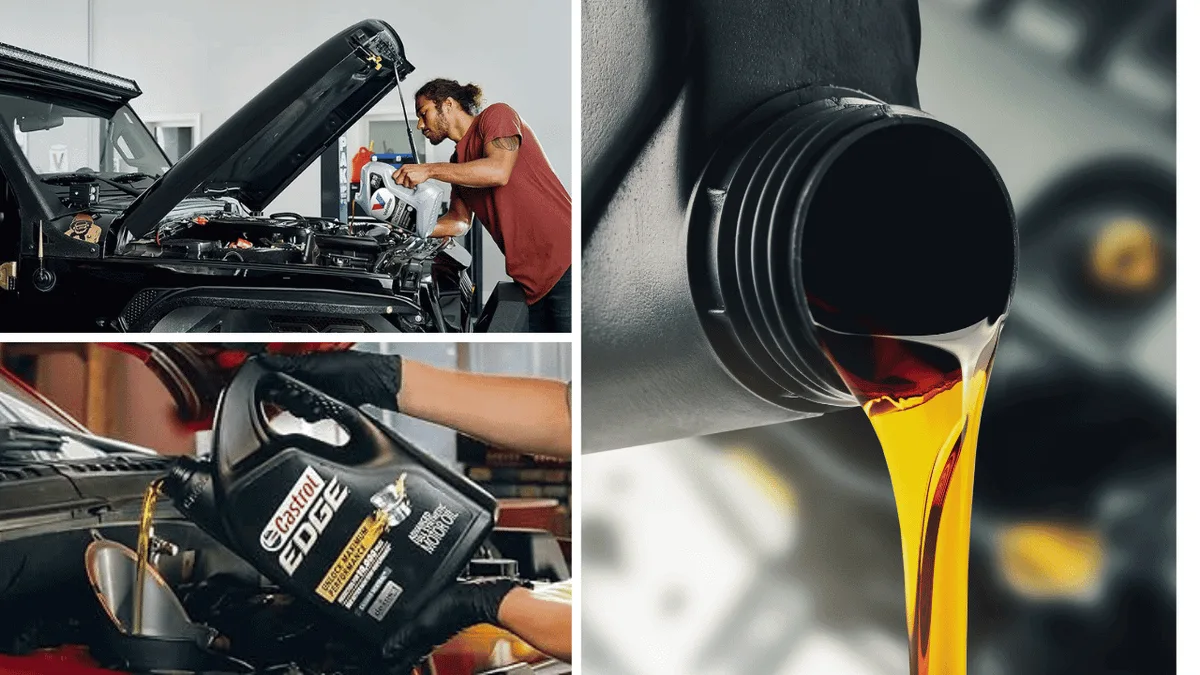
Image source: Bing (Web (fair-use with source credit))
Preparation and Safety
Park the Camry on level ground. Warm the engine for two to three minutes. Warm oil drains faster and carries more suspended contaminants.
Turn the engine off and let it sit for five minutes. This lets the oil settle back into the pan.
Jack up the front of the car if you need clearance. Use jack stands, not just the jack. The Camry sits low, and you may not fit a drain pan under it without raising it.
Draining the Old Oil
Locate the drain plug under the oil pan. The 2.5L engine has a 14mm bolt. The 3.5L V6 uses a 10mm bolt.
Place the drain pan underneath. Loosen the plug with a socket wrench, then unscrew it by hand. Keep pressure on the plug until the threads are clear.
Pull it away quickly to avoid splashing.
Let the oil drain for at least five minutes. The stream will slow to a drip. While it drains, move to the filter.
Replacing the Filter
For the 2.5L engine, unscrew the plastic filter housing cap. Use the cap wrench. Remove the old cartridge and the two O-rings.
Lubricate the new O-rings with fresh oil and install them. Place the new cartridge in the housing. Tighten the cap to 18 ft-lb.
For the 3.5L V6, unscrew the spin-on filter by hand. If it is stuck, use a filter wrench. Clean the mounting surface.
Lubricate the new filter's gasket with oil. Screw it on until the gasket contacts the base, then tighten another three-quarters of a turn.
Adding the Correct Amount
Install the drain plug with a new washer. Torque it to 29 ft-lb for both engines. Do not overtighten.
The aluminum oil pan threads strip easily.
Pour in the oil. For the 2.5L, start with 4 quarts. For the 3.5L, start with 5 quarts.
Screw the fill cap back on. Start the engine and let it idle for 30 seconds. The oil pressure light should turn off within a few seconds.
If it stays on, shut the engine down and check for leaks.
Checking the Dipstick and Resetting the Monitor
Turn the engine off and wait two minutes. Pull the dipstick, wipe it clean, insert it fully, and pull it again. The oil level should be between the low and full marks.
Add small amounts if needed. Do not overfill.
Reset the oil maintenance light. Turn the ignition to ON without starting the engine. Press the trip meter button until the oil wrench icon flashes.
Hold the button for five seconds until the icon disappears. The system is now reset.
Mistakes to Avoid During a Camry Oil Change
Even experienced DIYers make errors on the 2023 Camry. The dual engine options create confusion. Here are the most common pitfalls.
Ignoring the Engine Type Difference
The 2.5L and 3.5L engines have different capacities and different filter types. Putting 4.4 quarts in a V6 leaves it over a quart low. Putting 5.7 quarts in a four-cylinder overfills it badly.
Check your engine size before you buy oil. The VIN does not tell you the engine. Look at the sticker under the hood or the manual.
Forgetting the Filter Capacity
The capacities listed in the manual include the oil filter. If you reuse the filter, the system holds less oil. Adding the full 4.4 quarts without a filter change overfills the engine.
Always replace the filter and use the full capacity.
Overtorquing the Drain Plug
The drain plug torque is only 29 ft-lb. That is not very tight. Many people use a long ratchet and crank it to 50 ft-lb or more.
This strips the threads in the oil pan. The repair is a new oil pan or a thread insert. Use a torque wrench.
Using the Wrong Oil Filter
The 2.5L engine uses a cartridge filter. The 3.5L V6 uses a spin-on filter. They are not interchangeable.
A spin-on filter will not fit on the 2.5L engine. A cartridge will not fit on the 3.5L. Buy the correct part for your engine.
Skipping the Oil Change
Toyota's flexible maintenance system can suggest intervals up to 10,000 miles. That is only for ideal driving conditions. If you drive in stop-and-go traffic, cold weather, or dusty roads, change the oil every 5,000 miles.
Severe driving wears oil out faster.
When to Seek Professional Help
Some jobs are better left to a shop. If you do not have a torque wrench, skip the DIY oil change. Guessing the torque on the drain plug leads to stripped threads.
A shop has the correct tools and will torque everything properly.
If you have a leak after the oil change, take it to a mechanic. A leaking filter or drain plug can dump all the oil in minutes. Do not drive the car.
Have it towed if necessary.
If the check engine light comes on after the oil change, the oil pressure sensor may have been disturbed. A shop can scan the code and diagnose the issue. The cost is minimal compared to engine damage.
Frequently Asked Questions
Can I use 5W-30 in a 2023 Camry?
No. The engine is designed for 0W-20. 5W-30 is too thick and will not flow properly at cold temperatures. It also reduces fuel economy.
Switch to 0W-20 at the next change.
Is the oil capacity the same for the hybrid model?
Yes. The 2023 Camry Hybrid uses the same 2.5L four-cylinder engine. It holds 4.4 quarts with a filter change.
The hybrid system does not change the oil capacity.
How often should I change the oil?
Toyota recommends 5,000 to 10,000 miles depending on driving conditions. Under severe driving conditions, change it every 5,000 miles. Under ideal highway driving, 10,000 miles is acceptable.
Check the oil level monthly regardless.
What happens if I overfill the oil?
Overfilling causes the crankshaft to churn the oil into foam. This reduces oil pressure and leads to poor lubrication. Seals may leak.
Symptoms include blue smoke, rough idle, and oil leaks. Drain the excess immediately.
Can I use conventional oil instead of synthetic?
No. The 2023 Camry requires 0W-20 full synthetic. Conventional oil is not available in 0W-20.
Using a different viscosity defeats the purpose. Stick with synthetic.
Do I need to reset the oil light after a change?
Yes. The oil maintenance light must be reset manually. The procedure takes about 10 seconds.
If you do not reset it, the light stays on until the next service. Follow the trip meter button steps described above.
The Bottom Line: Verified Capacity and Best Practices
The 2023 Toyota Camry oil capacity is 4.4 quarts for the 2.5L engine and 5.7 quarts for the 3.5L V6. Use 0W-20 full synthetic oil with API SP or ILSAC GF-6 certification. Replace the oil filter every time.
Torque the drain plug to 29 ft-lb. Check the dipstick after filling. Change the oil every 5,000 to 10,000 miles depending on your driving habits.
These numbers come directly from Toyota engineering specifications. As of 2026, those specs have not changed for the Camry. Follow them and your engine will run smoothly for years.