
If you own a 2023 Toyota Corolla, you need to know exactly how much oil goes in before you crack the drain plug open. The 2023 toyota corolla oil capacity depends entirely on which engine is under the hood, and getting the number wrong by even half a quart can mean trouble.
Manufacturer specifications confirm two different powertrains in this generation. The gas-only model uses a 2.0-liter engine while the hybrid runs a smaller 1.8-liter unit. Each takes a different volume of oil.
As of 2026, Toyota still recommends its own 0W-16 synthetic oil for both, with the exact capacity varying between 4.0 and 4.4 quarts. Let's break down which number belongs to your car.
Why Getting the Oil Capacity Exactly Right Matters (and Why You Need to Care)
Modern Toyota engines run tight tolerances. The clearances between moving parts inside your Corolla's M20A-FKS or 2ZR-FAE engine are measured in microns. That means the oil viscosity and volume play a bigger role than in older cars where you could dump in five quarts and call it done.
Too little oil starves the bearings. Too much oil creates foaming. Foaming means air bubbles in the oil, and air doesn't lubricate.
Toyota's engineering team designed the oil pan, windage tray, and pump around a specific fill volume. Stray from that spec and you risk accelerated wear on the camshaft journals, rod bearings, and timing chain. The oil capacity spec in your owner's manual isn't a suggestion.
It's a calculated number.
There's another layer here. The 2023 Corolla uses 0W-16 oil, which is thinner than the 5W-30 most of us grew up using. Thin oil pumps faster at cold start, but it also leaves less margin for error.
A slightly incorrect fill level shows up faster in oil pressure readings. That's why the difference between 4.0 and 4.4 quarts actually matters on this car.
Quick Answer
The 2023 Toyota Corolla takes 4.4 quarts of oil with a filter change for the gas engine. The hybrid takes 4.0 quarts. Both use SAE 0W-16 full synthetic oil.
The oil must meet API SP or ILSAC GF-6B standards. Check your dipstick after filling to confirm the level.
Which Engine Does Your Corolla Have? (Gas vs. Hybrid)
You need to know which engine is in your car before you buy oil. It's not complicated, but it's easy to guess wrong.
Gas models use the 2.0-liter Dynamic Force Engine, code M20A-FKS. This engine produces 169 horsepower and is found in the Corolla LE, SE, XSE, and Nightshade trims. It has a timing chain, direct injection, and a variable oil pump.
This engine needs 4.4 quarts when you also change the oil filter.
Hybrid models use the 1.8-liter engine, code 2ZR-FAE. This is a smaller, older design paired with Toyota's hybrid system. It produces a combined 138 horsepower.
This engine needs 4.0 quarts when you also change the oil filter.
How to tell which one you have:
- Look at the badge on the trunk. If it says "Hybrid," you have the 1.8L.
- Pop the hood and check the engine cover. The 2.0L has a larger plastic cover with "Dynamic Force" molded into it.
- Check your VIN. The eighth character tells you the engine code. An "L" means the 2.0L gas engine.
The same oil type works for both engines. Only the quantity changes. We'll cover that in the next section.
If you're working on a newer model, the specs carry over. Our guide on the 2025 Toyota Corolla Oil Type confirms the same viscosity and capacity recommendations apply to later years as well.
The Right Oil: 0W-16 Isn't Optional
Toyota specifies 0W-16 full synthetic oil for the 2023 Corolla. This is not a suggestion. It is a requirement printed in the owner's manual and enforced by the warranty terms.
Why 0W-16?
The number "0W" means the oil flows at extremely cold temperatures. Winter starting in places like Minnesota or Ontario benefits from this. The "16" refers to the viscosity at operating temperature.
It is thinner than the more common 0W-20 or 5W-30.
Modern Corolla engines use variable valve timing and hydraulic tensioners that rely on precise oil pressure. Thicker oil delays actuation of these components. The engine computer also adjusts fuel mapping based on oil viscosity feedback from the oil pressure sensor.
Using 5W-30 could trigger a check engine light in some cases.
What the bottle must say:
| Certification | What it means | Required? |
|---|---|---|
| API SP | Current gasoline engine standard | Yes |
| ILSAC GF-6B | Fuel economy and wear protection | Yes |
| SAE 0W-16 | Viscosity grade | Yes |
| Full synthetic | Base oil type | Yes |
Where to find 0W-16:
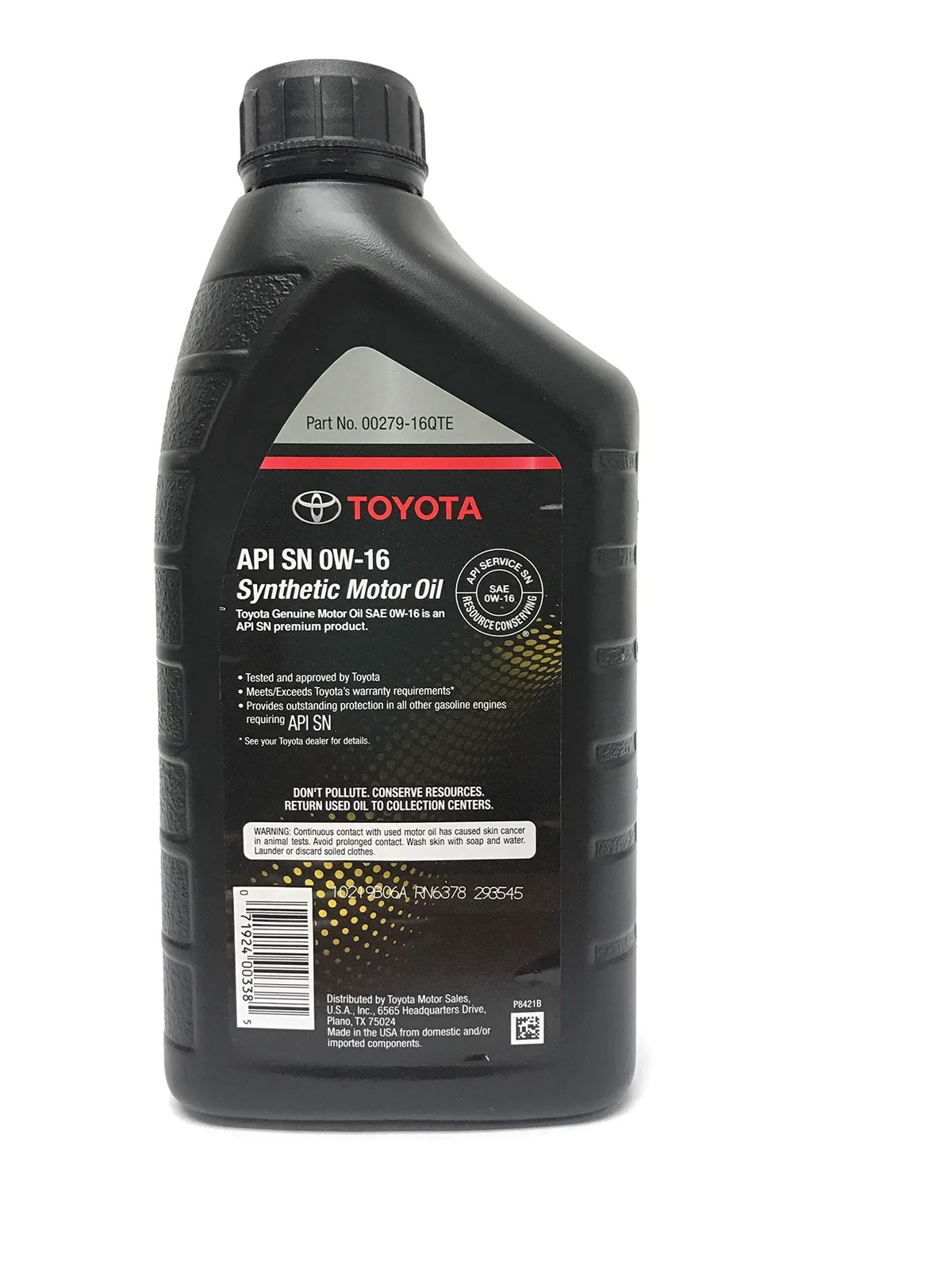
Toyota sells it under the "Toyota Genuine Motor Oil" label. Mobil 1, Pennzoil, Castrol, and Valvoline all produce 0W-16 synthetic oil that meets the required certifications. You can find it at auto parts stores, Toyota dealerships, and online retailers.
Can you use 0W-20 in a pinch?
Yes, but only as a temporary measure. Toyota states in the owner's manual that 0W-20 may be used if 0W-16 is not available. You should switch back to 0W-16 at the next oil change.
Do not run 0W-20 for a full interval and do not use any viscosity heavier than 0W-20. Using 5W-30 or 10W-30 is not recommended for this engine.
The same 0W-16 oil works across Toyota's current lineup. Our guide on the Toyota RAV4 Oil Type confirms that many newer Toyota models share the same viscosity recommendation.
Oil Capacity by Engine — Exact Quarts (With and Without Filter)
Here are the exact numbers. Write them down or bookmark this page.
2.0L Gas Engine (M20A-FKS)
| Fill condition | Quarts | Liters |
|---|---|---|
| With filter change | 4.4 | 4.2 |
| Without filter change | 4.0 | 3.8 |
| Dry engine (after rebuild) | 4.8 | 4.5 |
1.8L Hybrid Engine (2ZR-FAE)
| Fill condition | Quarts | Liters |
|---|---|---|
| With filter change | 4.0 | 3.8 |
| Without filter change | 3.6 | 3.4 |
| Dry engine (after rebuild) | 4.4 | 4.2 |
Important notes about these numbers:
The "with filter" number is the correct one for a standard oil change. The filter holds roughly 0.4 quarts of oil. If you skip replacing the filter, you should use the lower number.
Most people should always change the filter.
These numbers represent a refill after draining the old oil. A dry fill after an engine rebuild or replacement is higher because the oil cooler, passages, and pump are empty.
Always check the dipstick after filling. The numbers above will get you close, but the dipstick is the final authority. Add oil slowly once you reach the lower mark.
It takes about 10 seconds for the oil to drain down into the pan between pours.
Why the hybrid takes less oil:
The 1.8-liter engine is physically smaller. It has a smaller oil pan and fewer main bearing journals. The hybrid system also relies on the electric motor for low-load driving, which reduces engine runtime and thermal stress.
Toyota engineered the smaller sump to save weight and packaging space.
What about the Corolla Cross or Corolla Hatchback?
The Corolla Cross shares the same 2.0L engine and takes the same 4.4 quarts with filter. The Corolla Hatchback also uses the 2.0L engine. Same capacity.
Our guide on the 2026 Toyota Camry Oil Type shows how the larger Camry uses a different volume despite sharing the same oil viscosity.