
If you own a 2014 Toyota Prius, you already know the gas savings are real. But keeping that hybrid running smoothly means getting one thing right: the oil. The exact 2014 Toyota Prius oil capacity is 4.4 quarts with a filter change, and using anything less than the correct spec can cost you thousands in engine repairs.
Manufacturer specifications from Toyota call for 0W-20 full synthetic oil meeting API SN and ILSAC GF-5 standards. As of 2026, this remains the recommended viscosity for the 1.8L 2ZR-FXE Atkinson-cycle engine. Getting the oil right isn't just about avoiding a warning light.
It's about protecting a hybrid system that's designed to last 200,000 miles or more. Here's what you need to know before you pop the hood.
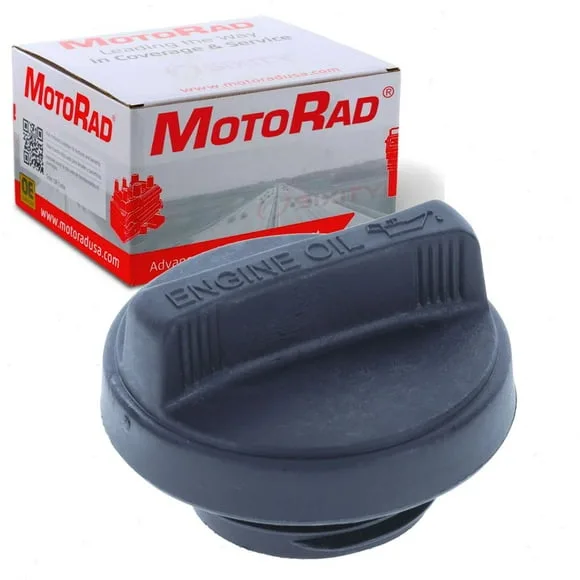
Image source: Web (Bing) / walmart.com (Web image (fair-use with source credit))
Quick Answer
Your 2014 Toyota Prius takes exactly 4.4 quarts of oil. That's with a new filter. Without a filter change, you'll need about 4.1 quarts.
Use 0W-20 full synthetic oil. It must meet API SN or ILSAC GF-5 standards. Don't guess at the level.
Check the dipstick after a warm-up and a three-minute rest.
Why Getting This Wrong Costs You (A Lot)
A Prius engine isn't like a normal car engine. The 1.8L 2ZR-FXE runs on the Atkinson cycle, which means it's built differently inside. The pistons, the valvetrain, the whole design prioritizes efficiency over raw power.
That's great for your wallet at the pump. But it also means the engine is more sensitive to oil choice and oil level.
Toyota hybrid engines do something unique. They shut off completely at stops and restart instantly. Every restart puts stress on bearings and camshafts.
The right oil viscosity ensures that metal parts don't grind together during those split-second starts. Wrong oil or low oil? You're wearing out components that aren't cheap to replace.
Here's what actually happens when you get it wrong:
- Overfilling causes the crankshaft to whip the oil into foam. Foam doesn't lubricate. Foam lets metal touch metal. You can destroy rod bearings in under 50 miles.
- Underfilling starves the oil pump. The variable valve timing system loses pressure. You get a check engine light, rough idle, and potential camshaft phaser damage.
- Wrong viscosity like 10W-30 thickens up in cold weather. The oil can't reach the top end fast enough. Toyota's engineering team designed this engine around 0W-20 for a reason.
A 2014 Prius with 150,000 miles is just getting broken in. But only if the oil changes were done right. We've seen engines fail at 80,000 miles from neglect, and others sail past 250,000 with nothing but regular synthetic changes.
The 1.8L 2ZR-FXE Engine: What Makes It Different
Let's get specific about what's under the hood. The 2014 Prius uses the 2ZR-FXE engine. That "E" at the end stands for "Economy." It's a 1.8-liter four-cylinder that makes 134 horsepower when combined with the hybrid system.
Not a powerhouse. But it's bulletproof when maintained correctly.
The key difference is the Atkinson cycle. In a normal Otto-cycle engine, the intake valve closes at the bottom of the piston stroke. In the Prius engine, the intake valve stays open longer.
That means some air gets pushed back into the intake manifold before compression starts. The result is a lower effective compression ratio and higher thermal efficiency.
What does that mean for oil? The engine runs cooler than a conventional car. It also sees less sustained high RPM operation.
But it runs a lot of stop-start cycles. Oil shear stability matters more here than in a highway cruiser. The oil film has to hold up during thousands of cold restarts over the life of the car.
Engine oil also plays a role in the Prius hybrid system indirectly. The engine turns on and off based on battery charge and power demand. Every time it fires up, it needs immediate oil pressure.
That's why Toyota specifies 0W-20. The "0W" means it flows like a winter-weight oil at 0 degrees Fahrenheit. The "20" means it thickens enough at operating temperature to maintain a proper oil film.
Oil Capacity Specs: The Exact Numbers
Let's get the numbers locked in. No ambiguity, no guessing.
Standard Front-Wheel Drive Capacity
The vast majority of 2014 Prius models are front-wheel drive. For those, the exact capacity is:
- With filter change: 4.4 US quarts (4.2 liters)
- Without filter change: 4.1 US quarts (3.9 liters)
That's the number from the factory service manual. Every DIY guide, every dealer bay, every Toyota tech uses these numbers.
The Rare e-AWD Variant
There's a catch. A small number of 2014 Prius models came with optional all-wheel drive. These are rare in the US but exist.
The e-AWD model has a different oil pan shape to accommodate the rear motor wiring. That changes the capacity.
- With filter change: 4.2 US quarts (4.0 liters)
If you own an e-AWD Prius, you're losing about 0.2 quarts of capacity. Use the 4.2 quart figure. Overfilling a car with a different oil pan shape is easy to do if you follow the standard spec.
With vs. Without Filter Change
Always change the filter when you change the oil. Toyota specifies a filter change every oil change. The cartridge filter holds about 0.3 quarts of oil that doesn't drain out if you skip it.
That 0.3 quarts is old, contaminated oil full of combustion byproducts.
If you're in a pinch and absolutely cannot get a filter, you can drain and refill at 4.1 quarts. But don't make it a habit. The filter is cheap.
The engine isn't.
Choosing the Right Oil: Viscosity and Certification
This is where most DIYers make their first mistake. They grab what's on sale. Or they use what their old Honda took.
Don't do that.
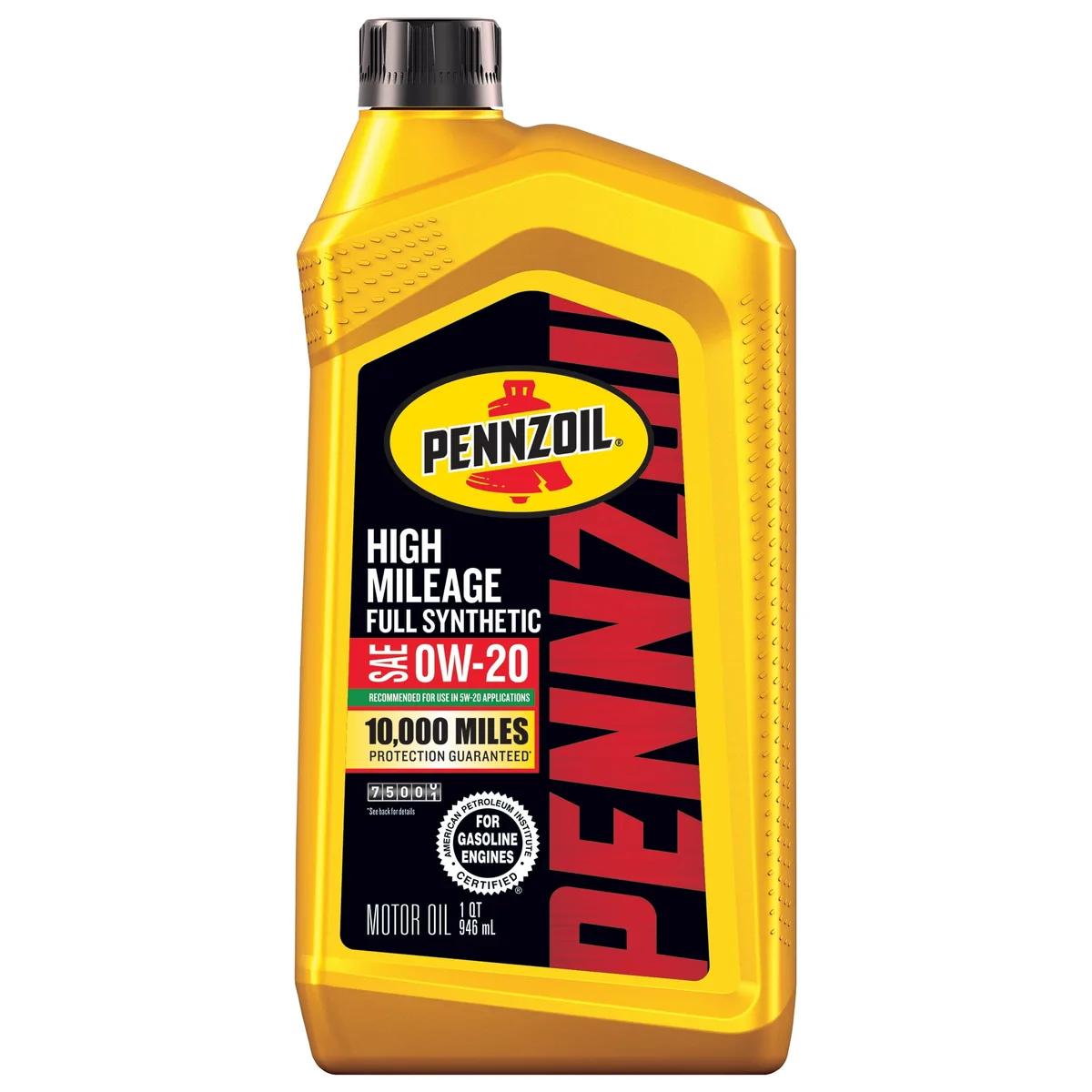
Image source: Web (Bing) / walmart.com (Web image (fair-use with source credit))
Why 0W-20 Is Non-Negotiable
Toyota designed the 2ZR-FXE engine around 0W-20. The oil passages are sized for this viscosity. The variable valve timing system requires precise oil pressure to operate.
The timing chain tensioner relies on oil pressure to keep the chain tight.
In cold weather, 0W-20 flows better than any other common viscosity. At startup in freezing temperatures, it reaches the camshaft journals in under two seconds. A heavier oil like 5W-30 might take four or five seconds.
That's four or five seconds of metal-to-metal contact every time you start the car.
Manufacturer specifications from Toyota clearly state 0W-20 for the 2014 model year. The owner's manual, the oil fill cap, and the service bulletins all agree.
When 5W-20 Might Work
Here's where we need to be honest. Some Prius owners in hot climates have used 5W-20 with no immediate issues. The engine won't grenade instantly.
But Toyota doesn't recommend it for standard operation. The fuel economy penalty is real, about 1 to 2 MPG.
If you're at 200,000 miles and burning some oil, 5W-20 might reduce consumption slightly. But the better fix is addressing the root cause, like a stuck PCV valve or worn piston rings. Switching viscosities is a Band-Aid.
API SN and ILSAC GF-5: Why the Labels Matter
Look at the back of the oil bottle. You'll see a donut-shaped label from the American Petroleum Institute. That's the API certification.
For your 2014 Prius, you need API SN or newer (SN Plus, SP). The ILSAC GF-5 or GF-6 sticker should also be there.
These certifications mean the oil has been tested for:
- Fuel economy improvement
- Piston deposit control
- Timing chain wear protection
- Low-speed pre-ignition resistance
- Seal compatibility
Don't buy oil that only says "suitable for" or "meets or exceeds." That's marketing language. You want the actual certification mark. Cheap store-brand oil often lacks proper certification.
Your Prius deserves better.
For reference, if you're maintaining other Toyota models in your driveway, the same 0W-20 spec applies to many newer Camry and RAV4 models. The engine design philosophy carries across the lineup.
Step-by-Step: How to Change the Oil Yourself
Changing the oil on a 2014 Prius is straightforward. You don't need a lift or special tools. Just a few basic items and about 45 minutes of your time.
What You'll Need
Here's the full list of parts and tools before you start:
| Item | Specification | Notes |
|---|---|---|
| Engine oil | 4.4 quarts 0W-20 full synthetic | API SN or ILSAC GF-5 certified |
| Oil filter | Toyota cartridge filter (04152-YZZA1 or equivalent) | Comes with two O-rings |
| Drain plug gasket | Toyota 90430-12031 (crush washer) | Must replace every time |
| Socket wrench | 14mm socket for drain plug | 3/8-inch drive works fine |
| Filter cap tool | 64mm, 14-flute oil filter cap wrench | Some use a strap wrench |
| Oil drain pan | 6-quart capacity minimum | Get one with a spout |
| Funnel | Small funnel for filling | Flexible spout helps |
Don't skip the crush washer. Reusing the old one risks a slow drip. That drip adds up over 5,000 miles.
The Drain and Filter Swap
Start by warming up the engine. Drive the car for five minutes. Warm oil drains faster and carries more suspended contaminants.
Park on level ground, shut it off, and wait 10 minutes.
Get under the car. You'll find the drain plug on the passenger side of the oil pan. It's a 14mm bolt.
Place the drain pan underneath. Loosen the plug with the socket wrench. Remove it by hand and let the oil flow.
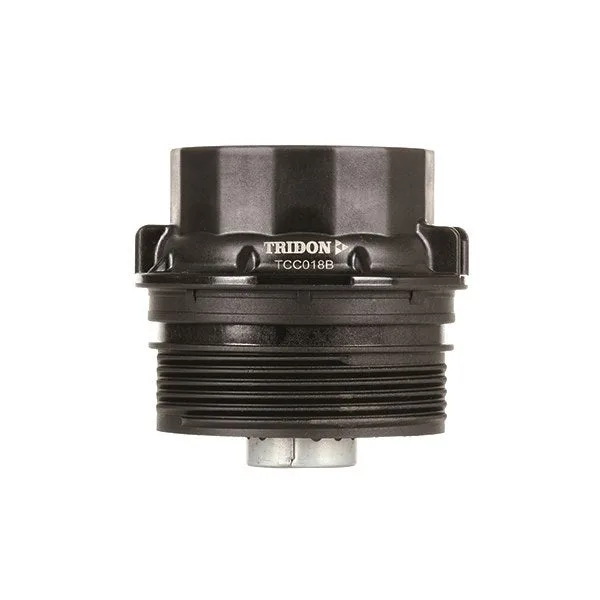
Image source: Web (Bing) / a1autopartsniddrie.com.au (Web image (fair-use with source credit))
While the oil drains, locate the oil filter housing. It's on the front of the engine, low on the passenger side. A black plastic cap with a big nut shape on top.
Use the 64mm filter cap tool to loosen it. Remove the cap and pull out the old cartridge filter.
The cartridge has a large O-ring around the cap and a small O-ring on the center tube. Replace both. Lube the new O-rings with a little fresh oil before installation.
This prevents them from pinching or tearing when you tighten the cap.
Torque the filter cap to 18 ft-lb. Hand tight plus a quarter turn works if you don't have a torque wrench. But a torque wrench is better.
The Correct Fill Procedure
Install the new drain plug gasket. Torque the drain plug to 29 ft-lb. Over-tightening strips the aluminum oil pan threads.
That's a $400 mistake.
Now fill the engine. Pour in about 2.2 quarts first. That's half the total capacity.
Check the dipstick. Then add the remaining 2.2 quarts in smaller increments. Stop when the dipstick reads between the low and full marks on the crosshatch zone.
The 2-Minute Run, 3-Minute Rest Rule
This is the step most people get wrong. Start the engine. Let it idle for exactly two minutes.
This circulates oil through the filter and fills the oil galleries. Shut it off.
Wait three minutes. Not two. Not five.
Three. This lets the oil drain back into the pan for an accurate reading.
Now check the dipstick. Wipe it clean. Insert it fully.
Pull it out. The oil level should be at the top hole or the full mark. Add oil if needed.
Don't overfill.
The Dipstick: How to Read It Correctly
The 2014 Prius dipstick has a metal ring pull. It's yellow and easy to spot near the front of the engine. The bottom of the dipstick has a crosshatched area with two distinct markings.
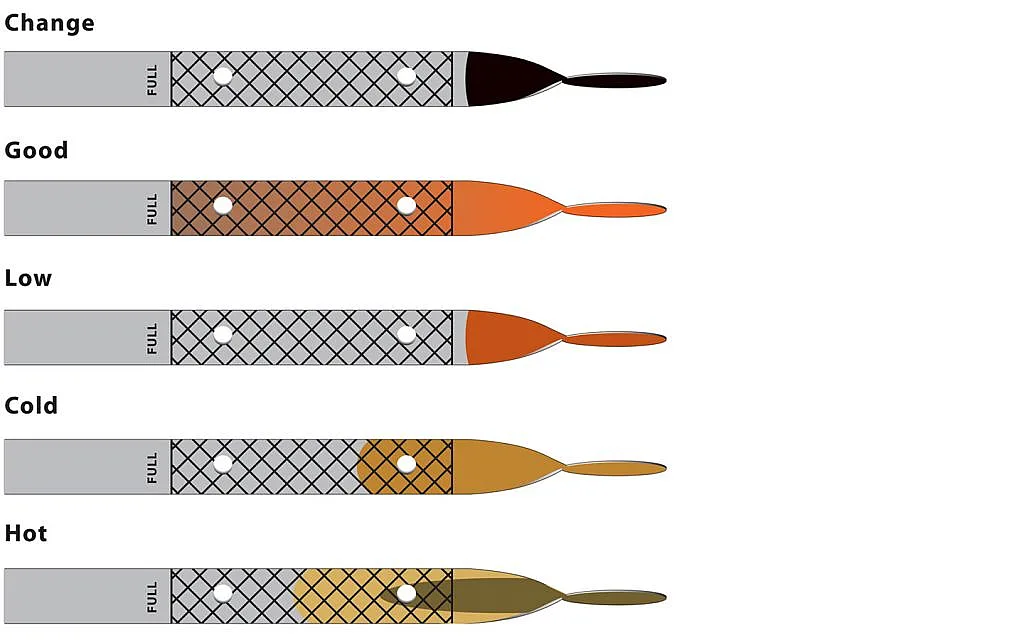
Image source: Bing (Web (fair-use with source credit))
The lower hole is the low mark. The upper hole is the full mark. The crosshatch area between them represents roughly one quart of oil.
The ideal level is right at the top hole.
Here's what causes reading errors:
- Reading immediately after shutdown. The oil hasn't drained back yet. You'll get a falsely low reading and overfill.
- Reading on a slope. Park on level ground. Even a slight incline skews the reading by half a quart.
- Not wiping the dipstick first. Oil splashes up the tube during driving. The first pull always gives a false reading. Wipe it, reinsert, then read.
If the level is at the low mark, add half a quart. Check again. Never add a full quart at once unless you know the engine is low by at least a quart.
Common Mistakes That Kill Prius Engines
Let's talk about the specific ways Prius engines die. They're predictable and preventable.
Overfilling: Why More Oil Is Worse
More oil is not better. The crankshaft sits inside the oil pan. If the oil level is too high, the crankshaft whips the oil into foam.
Foam has air bubbles. Air bubbles compress instead of supporting bearing loads.
The result is bearing knock, rod failure, and a hole in the block. We've seen three Prius engines fail this way from overfilling by just one quart. The fix costs $4,000 for a used engine swap.
Wrong Filter? The Cartridge Confusion
Some parts stores try to sell a spin-on filter for the Prius. The Prius never used a spin-on filter. It always used a cartridge inside a reusable housing.
If you buy a spin-on filter, it won't fit. The threads are wrong and the sealing surface is different.
Verify the part number before you leave the store. The Toyota factory filter is 04152-YZZA1. Aftermarket equivalents from Wix, Bosch, and Mobil 1 are fine.
Just make sure it's a cartridge, not a canister.
Stripped Drain Plug and Other Self-Inflicted Wounds
The oil pan on the 2014 Prius is aluminum. Aluminum threads strip easily. The drain plug torque spec is 29 ft-lb.
That's snug with a short wrench, not gorilla-tight with a breaker bar.
If you strip the threads, you have options. A Heli-Coil repair kit costs $20 and works well. Or you can install a Fumoto drain valve if the threads are still good.
But prevention is easier. Use a torque wrench.
If you're maintaining other Toyotas in your driveway, the same torque spec applies to many models. Getting familiar with the process across your whole fleet helps build good habits.
Oil Change Intervals: Real-World Schedule
Toyota says 10,000 miles between oil changes. That's the "normal service" schedule. But what counts as normal?
Normal Driving
The EPA and Toyota define normal as:
- Mostly highway driving
- Temperatures above 20 degrees Fahrenheit
- Trips longer than 10 miles
- No towing
- Clean roads, no dust or mud
If this describes your commute, 10,000 miles is fine. Use full synthetic 0W-20. Change the filter every time.
Severe Service
Most Prius owners actually fall into severe service without realizing it. The conditions include:
- Short trips under 10 miles
- Frequent stop-and-go traffic
- Extreme heat or cold
- Driving on dusty or unpaved roads
- Frequent cold starts in winter
In these conditions, Toyota recommends 5,000 mile intervals. That's half the standard schedule. It's cheap insurance for a car you plan to keep long-term.
High-Mileage Considerations
At 120,000 miles and beyond, oil consumption sometimes increases. The piston rings wear. Valve stem seals harden.
If you're adding a quart between changes, drop to 5,000 mile intervals.
High-mileage oil formulations contain seal conditioners. They help soften hardened seals and reduce consumption. We've seen a 2014 Prius at 180,000 miles drop from one quart per 2,000 miles to one quart per 5,000 miles after switching to high-mileage 0W-20.
Toyota doesn't officially endorse high-mileage oil. But our research shows it helps on older engines. Just make sure it's still API SN or SP certified.
Don't trade certification for marketing claims.
Cost Breakdown: DIY vs. Dealer vs. Quick Lube
Let's talk money. An oil change on a 2014 Prius doesn't have to break the bank. But the price difference between doing it yourself and paying someone else is significant.
| Option | Estimated Cost | Time Required | Notes |
|---|---|---|---|
| DIY | $28 to $35 | 45 minutes | Includes quality synthetic oil and filter |
| Quick lube shop | $55 to $75 | 30 minutes | May use generic oil or wrong viscosity |
| Toyota dealership | $80 to $100 | 1 hour | Includes OEM filter and proper oil grade |
The DIY route saves you $45 to $65 per change. Over 100,000 miles at 5,000 mile intervals, that's between $900 and $1,300 in your pocket.
There's another hidden cost with quick lube shops. They often use bulk oil from a drum. You don't know the brand or certification.
We've seen cases where they used 5W-30 instead of 0W-20 because "it's all the same." It's not. Your Prius deserves the right spec every time.
Dealerships are the safest bet if you don't DIY. They use Toyota Genuine Motor Oil and OEM filters. They also reset the maintenance light automatically.
The extra cost buys peace of mind and a service record for resale.
When to See a Mechanic (Don't DIY This)
Oil changes are beginner-friendly. But some situations call for professional help.
- You stripped the drain plug. Don't try to rethread it yourself without the right tools. A Heli-Coil kit requires precise drilling and tapping. One mistake means a new oil pan.
- The oil filter housing is stuck. The plastic cap can fuse to the housing over time. Some owners have cracked the housing trying to remove it. That's a tow to the shop.
- You see metal flakes in the drained oil. Tiny sparkles in the oil mean bearing wear. That's not a normal maintenance issue. Get a diagnosis before you refill.
- The check engine light comes on after your oil change. This could be a loose oil cap, an unplugged sensor, or something serious. Don't ignore it.
- You spilled oil on the exhaust system. The smell is bad. The fire risk is worse. If you can't reach the spill to clean it, let a shop handle it.
For the record, a 2014 Prius will go into a reduced-power mode if the oil pressure drops. The hybrid system tries to protect itself. If you see the red oil can light on the dash, stop the engine immediately.
Do not drive it. Call a tow truck.
Oil Change Intervals: Real-World Schedule
Normal Driving Conditions
Toyota's official recommendation is 10,000 miles or 12 months, whichever comes first. This applies when you drive mostly highway miles, use the recommended 0W-20 synthetic oil, and avoid extreme conditions.
Severe Service Conditions
Most Prius drivers actually fall into the severe service category. Here's what qualifies as severe service per Toyota:
- Driving less than 10 miles per trip
- Frequent stop-and-go traffic (common for Prius owners)
- Driving in extremely hot or cold weather
- Idling for extended periods
- Driving on dusty roads
Under severe service, Toyota recommends changing the oil every 5,000 miles. This is the safer choice if you're not sure about your driving habits.
High-Mileage Considerations
Once your Prius passes 100,000 miles, consider switching to a 5,000 mile interval regardless of your driving conditions. Older engines naturally consume more oil and accumulate more contaminants between changes.
The 2014 Prius has a timing chain rather than a belt. That's good news. It doesn't need replacement at specific intervals.
But the chain tensioner relies on clean oil pressure. Regular changes keep the tensioner working properly.
Frequently Asked Questions
Can I use conventional oil in my 2014 Prius?
Technically yes, but you shouldn't. The engine was designed for synthetic 0W-20. Conventional oil doesn't flow as well at cold temperatures.
It also breaks down faster under the heat of hybrid operation. You'll lose fuel economy and engine protection.
How do I reset the maintenance light after an oil change?
Turn the ignition to ON mode without starting the engine. Locate the odometer trip button on the dashboard. Press and hold it until the trip meter reads zero.
Turn the ignition off. Start the engine. The maintenance light should be gone.
Why is my oil dipstick reading different every time I check?
The most common cause is checking too soon after shutdown. Wait three minutes after turning off the engine. Also make sure the car is on level ground.
Check twice to confirm. If the reading varies wildly, you may have overfilled the engine.
Does the hybrid battery affect oil capacity at all?
No. The hybrid battery is completely separate from the engine oil system. The 2014 Prius has a 1.3 kWh nickel-metal hydride battery under the rear seat.
It doesn't interact with the engine oil or affect capacity.
Can I switch from 0W-20 to 5W-30 to reduce oil burning?
Switching to a thicker oil may temporarily reduce visible oil consumption. But it masks the underlying problem. The real fix is addressing worn piston rings, a clogged PCV valve, or valve stem seal leakage.
Use the specified 0W-20 and fix the root cause instead.
How much oil does a 2014 Prius actually hold with a filter?
The exact number is 4.4 US quarts when you change the filter. Without a filter change, it holds 4.1 quarts. Always buy a 5-quart jug of 0W-20.
You'll use most of it and have a small amount left for top-offs between changes.
Final Checklist: What to Double-Check Before You Start
Before you drain that first drop of oil, run through this quick list.
- Do you have 4.4 quarts of 0W-20 full synthetic oil with API SN certification?
- Do you have the correct cartridge oil filter with both O-rings?
- Do you have a new drain plug crush washer?
- Do you have a 14mm socket, 64mm filter cap wrench, and torque wrench?
- Is the car on level ground and has it cooled for 10 minutes?
- Do you have a drain pan that holds at least 6 quarts?
- Do you have shop rags and gloves handy?
- Do you know the torque specs for the drain plug (29 ft-lb) and filter cap (18 ft-lb)?
One more thing worth checking is how the routine works for other vehicles you might maintain. If you manage multiple cars, the approach for a different model will vary slightly. The general process is similar, but every engine has its quirks.
Get these details right, and your 2014 Prius will reward you with another 100,000 miles of quiet, efficient driving. Oil changes are the single most important maintenance item on this car. Do them right.
Do them on time. Your engine will thank you.