
The 2010 toyota prius problems list is longer and costlier than most owners expect. This generation introduced a new engine and transaxle that changed the failure profile. Three safety recalls affect braking and stalling risks.
Hybrid battery and inverter repairs can exceed the car's value.
The 2010 model uses a 1.8 liter 2ZR-FXE engine with an electric water pump and no timing belt. Manufacturer specifications indicate 50 mpg combined EPA rating. Real world data shows 44 to 48 mpg typical.
Understanding the specific failure modes helps you decide whether to buy fix or walk away.

Image source: Bing (Web (fair-use with source credit))
Quick Answer
The 2010 Prius has three safety recalls. Brake actuator failure causes soft pedal. Inverter failure stalls the engine.
Hybrid battery degrades after 8 to 12 years. Head gasket blows from EGR carbon buildup. Repair costs often exceed resale value.
Why the 2010 Prius Demands Different Scrutiny Than Other Years
The 2010 Prius launched the third generation with a larger 1.8 liter engine. Toyota redesigned the transaxle to handle more torque. They switched from a belt driven water pump to an electric unit.
The brake system moved to a fully hydraulic brake by wire actuator. These changes created new failure modes not seen in the 2004 to 2009 models.
The inverter converter assembly sits atop the transaxle and manages high voltage power flow. Its MG2 inverter module fails at a higher rate than the previous generation. The EGR cooler design traps carbon which then migrates into the cylinder head.
Oil control rings stick and consumption spikes. The brake actuator accumulator membrane ruptures internally. Each issue appears in technical service bulletins specific to the 2010 through 2015 production run.
Mileage changes the math. A 2010 with 80000 miles faces different risks than one with 180000. The hybrid battery warranty expired for most federal state cars.
CARB state coverage extends to 150000 miles. Inverter extended warranty covers 10 years or 150000 miles. Brake actuator recall has no mileage limit.
Knowing which coverage applies to your VIN changes the repair decision.
The Three Safety Recalls You Cannot Ignore
Three NHTSA recalls affect the 2010 Prius. Each addresses a safety critical system. Dealers must perform these repairs at no cost.
Verify completion using the NHTSA VIN lookup tool.
| Recall ID | Component | Hazard | Remedy |
|---|---|---|---|
| 14V-353 / 15V-344 | Brake actuator | Internal leak causes soft pedal and extended stopping distance | Replace brake actuator assembly |
| 20V-090 | Combination meter | Speedometer and fuel gauge go blank while driving | Software update or meter replacement |
| 18V-578 | Inverter software | Engine stalls without warning at speed | ECU reprogram only |
The brake actuator recall expanded in 2015 to cover more VINs. The original 2014 campaign missed early build units. The combination meter recall addresses a software glitch that blanks the instrument cluster.
The inverter software update prevents a stall condition but does not fix hardware failure. Check all three before buying or budgeting repairs.
Inverter Failure: The $3,000 Gamble That Strands You

The inverter converter assembly converts DC battery power to three phase AC for the motor generators. The MG2 inverter module drives the main traction motor. It fails due to thermal cycling stress on the power transistors.
Symptoms include a flashing ready light master warning triangle and loss of motive power. Codes P0A78 and P0A94 set in the hybrid ECU.
Toyota issued TSB EG013-03 extending inverter warranty to 10 years or 150000 miles. This coverage applies regardless of ownership. If your VIN qualifies the dealer replaces the entire inverter converter assembly free.
Out of warranty cost runs $2800 to $3500 at a dealer. Independent hybrid shops charge $1200 to $1800 using remanufactured units from suppliers like Hybrid Revolt or Green Bean Battery.
Heat accelerates failure. Cars in Arizona Texas and Florida see higher rates. The inverter has its own coolant loop with a dedicated reservoir.
Pink super long life coolant must be changed at 100000 miles. Neglecting this service voids the extended warranty. Check the inverter coolant level and condition during any pre purchase inspection.
Hybrid Battery: Degradation Curves Warranty Windows and Real Replacement Costs
The nickel metal hydride pack contains 28 modules wired in series. Nominal voltage is 201.6 volts. Capacity fades as modules develop internal resistance imbalance.
The battery ECU monitors each block voltage. When variance exceeds threshold it sets P0A80 replace hybrid battery pack. The triangle of death illuminates.
Federal emissions warranty covers 8 years or 80000 miles. CARB states extend to 10 years or 150000 miles. As of 2026 most federal 2010 units are outside coverage.
CARB state cars may still qualify depending on registration history. Verify status through a dealer OASIS report before assuming coverage.
Replacement options vary widely in cost and longevity. New OEM pack from Toyota costs $2700 plus $800 labor. Remanufactured packs from reputable rebuilders run $1300 to $1600 installed with 1 to 3 year warranty.
Grid charging and deep cycling can restore 10 to 20 percent capacity for $300 in equipment. This buys 12 to 24 months but does not fix degraded cells.
Block voltage analysis requires a Techstream scan tool or the Dr Prius app with a mini VCI cable. Healthy packs show less than 0.2 volt spread under load. A spread over 0.5 volt indicates modules nearing end of life.
Temperature sensors in the pack also fail and trigger false codes. Replace the sensor harness first if block voltages look balanced.
Head Gasket and EGR: The Carbon Chain Reaction That Kills Engines
The EGR cooler recirculates exhaust gas to lower combustion temperature. On the 2010 Prius the cooler passages clog with carbon sludge by 100000 miles. Restricted flow raises cylinder temperature.
The multi layer steel head gasket fails between cylinders one and two. Coolant enters the combustion chamber on cold start. Misfire codes P0301 and P0302 appear.
The engine shakes violently for the first 10 seconds.
Cleaning the EGR system prevents head gasket failure. The procedure removes the intake manifold throttle body EGR valve cooler and pipe. Carbon deposits scrape out with picks and solvent.
Reassembly uses new gaskets. A shop charges $600 to $900. DIY cost is $50 in gaskets and six hours.
Skip this service and the head gasket job costs $2200 to $3000 including timesert block repair if the aluminum threads strip.
Oil consumption accompanies this failure mode. Stuck oil control rings allow oil past the pistons. One quart per 1000 miles is common on neglected engines.
A compression test confirms ring sealing. Healthy cylinders read 170 psi minimum with less than 10 percent variance. Low compression on cylinders one and two with coolant loss confirms head gasket breach.
The water pump bearing fails independently. A whining noise from the front of the engine signals imminent seizure. Overheating follows quickly.
Replace the electric water pump at 100000 miles as preventive maintenance. The part costs $180. Labor adds $200 to $400.
Using Toyota SLLC pink coolant protects the pump seals and inverter coolant loop.
Brake Actuator: Why the Pedal Goes Soft and What the Recall Actually Covers
The brake actuator combines the master cylinder hydraulic booster and accumulator in one unit. It provides power assist for the hydraulic brakes and manages regenerative braking blend. The accumulator stores high pressure brake fluid using a nitrogen charged membrane.
That membrane ruptures over time. Fluid leaks into the gas chamber. The pump runs constantly trying to recharge pressure.
The pedal feels soft and travels farther. Warning lights illuminate for ABS VSC and brake system.
Recall 14V-353 expanded by 15V-344 covers the actuator replacement for all 2010 models. The repair takes two to four hours at a dealer. Parts availability has improved but delays still occur.
The recall does not cover brake fluid contamination from the internal leak. Flush the system after the actuator swap. Use only DOT 3 fluid from a sealed container.
The brake actuator bleed procedure requires Techstream for linear valve calibration. A manual bleed leaves air in the simulator circuit.
Codes C1256 and C1345 indicate accumulator pressure loss. The pump motor may set C1252 if it overheats from continuous operation. Do not drive with these codes active.
Braking distance increases significantly. The recall repair is free regardless of mileage or ownership. Verify completion on the NHTSA site before purchasing any 2010 Prius.
The Silent Killers: Water Pump 12V AGM Combination Meter Oil Consumption
The electric water pump circulates coolant through the engine and inverter loops. Its bearing seizes without warning. The engine overheats within minutes.
A whining noise from the passenger side front signals imminent failure. Replace the pump at 100000 miles as preventive maintenance. The part costs one hundred eighty dollars.
Labor adds two to four hundred. Use only Toyota SLLC pink coolant. Mixing coolant types destroys the pump seal.
The 12 volt AGM battery sits in the trunk. It powers the ECU network and enables the hybrid system to boot. When it fails the car shows no ready light and strange dash warnings.
Jump starting works but the AGM must be load tested. Replace with a proper AGM unit like the Optima DS46B24R or Duralast H6. Standard flooded batteries fail quickly in this application.
Cost runs two hundred twenty to two hundred eighty dollars.
The combination meter failure blanks the speedometer fuel gauge and odometer. Recall 20V-090 addresses this with a software update. Some units need full replacement.
Mail in repair services charge two hundred to three hundred dollars. Dealers charge six hundred. The odometer stops recording miles during the failure.
This creates title discrepancies at resale.
Oil consumption stems from stuck oil control rings. Carbon buildup from the EGR system gumms the rings. The engine burns one quart per thousand miles.
Topping off masks the symptom. The fix requires piston ring replacement or engine swap. Compression testing confirms ring sealing.
Healthy cylinders read one hundred seventy psi minimum with less than ten percent variance.
Pre-Purchase Inspection: What a Techstream Scan Reveals That a Test Drive Won't
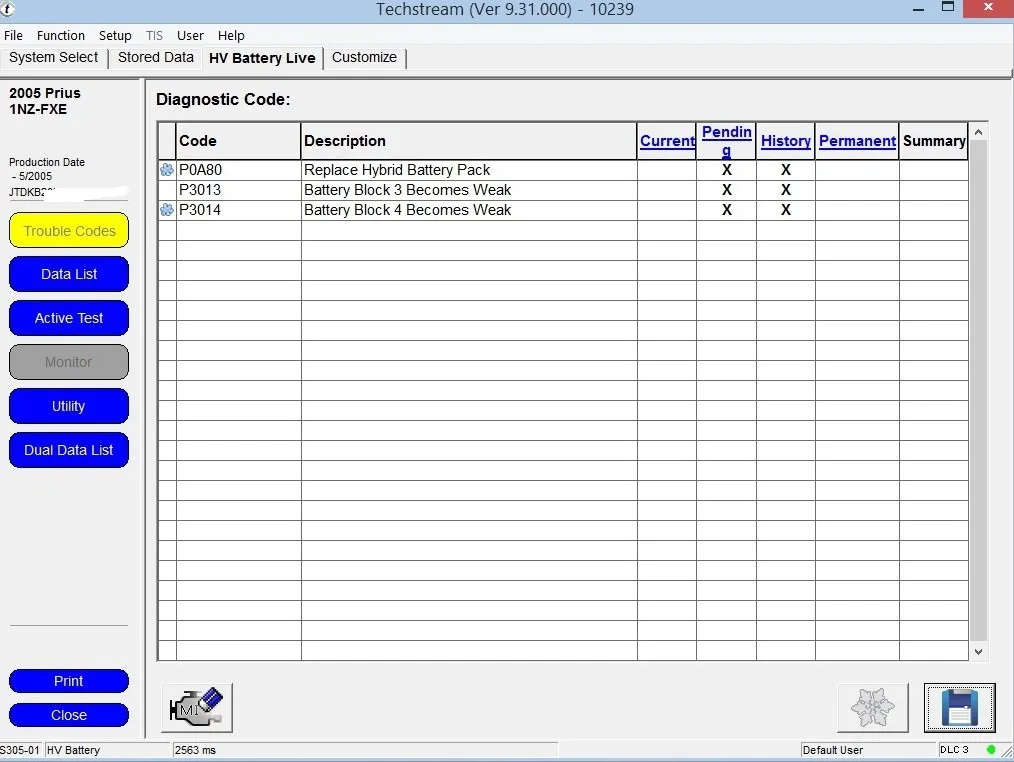
A test drive cannot reveal hybrid battery block imbalance or brake accumulator pressure decay. You need a Techstream scan tool or a mini VCI cable with the Dr Prius app. Connect to the OBD2 port under the dash.
The hybrid data stream shows individual block voltages under load. Healthy packs show less than zero point two volt spread. A spread over zero point five volt means modules are failing.
Check MG1 and MG2 motor temperatures. They should track within ten degrees of each other. A hot MG2 indicates inverter thermal stress.
Read the brake actuator pressure sensor value. It should hold steady around fifteen megapascals at rest. Dropping pressure confirms accumulator membrane leak.
The live data shows inverter coolant temperature separate from engine coolant. Both should stabilize near ninety degrees Celsius.
Pull all ECU codes including history codes. The hybrid ECU stores pending codes that do not illuminate the dash. Look for P0A80 P0A78 P0401 P0301 P0302 C1256.
Check the EGR valve step count. High counts indicate carbon restriction. Verify the water pump duty cycle.
It should modulate smoothly not hunt. The 12V battery voltage should read twelve point six volts at rest and stay above ten volts during boot.
A thorough scan takes thirty minutes. Most independent hybrid shops charge one hundred to one hundred fifty dollars for a pre purchase inspection. That fee saves thousands in surprise repairs.
Bring a laptop with Techstream or a Bluetooth OBD2 adapter and phone app. The Dr Prius app costs twenty dollars and works with a fifty dollar mini VCI cable. This is the single best investment before buying any 2010 Prius.
Repair Math: When Fixing Makes Sense vs When You're Throwing Good Money After Bad
Private party value for a clean running 2010 Prius with one hundred fifty thousand miles sits around forty five hundred to six thousand dollars. The same car needing a hybrid battery or inverter drops to twelve hundred to two thousand dollars. Repair costs determine the decision.
A remanufactured battery at sixteen hundred installed plus an EGR clean at eight hundred totals twenty four hundred. That leaves positive equity if the car runs well otherwise.
Head gasket replacement at twenty five hundred combined with a battery at sixteen hundred hits forty one hundred. At that point you approach the car's value. Add an inverter failure and you exceed it.
The brake actuator recall is free. The combination meter recall is free. The inverter software update is free.
Factor those in before writing off the car.
Rideshare drivers face different math. High annual mileage spreads repair costs over more revenue miles. A three thousand dollar repair amortized over fifty thousand miles per year is six cents per mile.
A private commuter driving twelve thousand miles per year pays twenty five cents per mile. The use case changes the threshold.
Create a repair budget spreadsheet. List every known issue with parts and labor estimates. Subtract the total from the repaired retail value.
If the result is negative walk away. If positive but thin negotiate the price down by the repair estimate plus twenty percent for risk. Never buy a 2010 Prius with unresolved recall work assuming you will get it done later.
The dealer may not have parts in stock.
Maintenance That Actually Prevents the Major Failures
Change the transaxle fluid every sixty thousand miles using Toyota WS fluid only. The fill procedure uses the overflow plug method with the engine cold. Capacity is three point two quarts.
Neglecting this service starves the motor generator bearings. The fluid darkens but does not smell burnt. Black fluid with metal glitter means transaxle damage.
Clean the EGR system at one hundred thousand miles or sooner if oil consumption appears. Remove the intake manifold throttle body EGR valve cooler and pipe. Scrape carbon deposits with plastic picks and brake cleaner.
Reassemble with new gaskets. This single service prevents the head gasket failure chain. Cost is fifty dollars DIY or six hundred to nine hundred at a shop.
Replace the engine coolant and inverter coolant at one hundred thousand miles. Use pink SLLC pre mixed. The inverter loop holds one point two quarts.
The engine loop holds six point eight quarts. Bleed both systems using the Techstream coolant bleed procedure. Air pockets cause hot spots and inverter failure.
Inspect the brake actuator accumulator pressure at every oil change using Techstream. Pressure should hold above fifteen megapascals for ten minutes with the car off. Decay indicates membrane leak.
Catch it early and the recall covers replacement. Wait for the soft pedal and you risk a crash.
Change the 12V AGM battery proactively at five years regardless of test results. The trunk location bakes the battery in summer. A weak 12V stresses the DC DC converter and hybrid ECU.
The two hundred dollar battery prevents thousand dollar module failures. Keep the hybrid battery fan filter clean. Vacuum it every oil change.
Restricted airflow cooks the pack.
CARB States vs Federal: How Your Zip Code Changes the Warranty Picture
California and eleven other states follow CARB emissions rules. Those states extend hybrid battery coverage to ten years or one hundred fifty thousand miles. The federal warranty stops at eight years or eighty thousand miles.
As of 2026 most 2010 models in federal states have no battery coverage left. CARB state cars may still qualify if the original registration was in a covered state. Check the emissions label under the hood.
It lists the certification standard. A dealer OASIS report confirms remaining warranty using the VIN.
Inverter extended warranty covers ten years or one hundred fifty thousand miles nationwide. That coverage came from a customer support program not a recall. It applies regardless of state.
Brake actuator recall has no mileage or time limit. Combination meter recall also has no limit. These three safety repairs are free everywhere.
The difference is purely the hybrid battery. If you live in a federal state and the battery fails you pay. If you move a CARB car to a federal state the warranty follows the vehicle.
Document the original registration state when buying.
Decision Guide: Keep Fix or Walk Away Based on Mileage Codes and Budget
Start with a Techstream scan. No codes and healthy block voltages mean the car is a keeper. Budget two thousand for preventive EGR clean and transaxle fluid.
If P0A80 appears with block spread over zero point five volt the battery needs replacement. Add sixteen hundred for a reman unit. If P0A78 or P0A94 shows the inverter is failing.
Add eighteen hundred for a reman inverter. If P0301 P0302 with coolant loss the head gasket is blown. Add twenty five hundred for the repair plus EGR clean.
Add the repair estimates together. Compare to the repaired retail value of four thousand to six thousand. If repairs exceed three thousand walk away unless you do the work yourself.
If repairs total one thousand to two thousand negotiate the price down by that amount plus twenty percent. The brake actuator recall is free so do not deduct for it. The combination meter recall is free.
The inverter software update is free.
Rideshare drivers can justify higher repair spend. High mileage spreads cost over revenue. Private commuters should be stricter.
A car needing battery inverter and head gasket is a parts car. Value drops to twelve hundred. Do not sink money into a cascade failure.
Buy the cleanest example you can afford. Maintenance history matters more than mileage.
Frequently Asked Questions
What is the most expensive repair on a 2010 Prius?
The inverter converter assembly replacement costs twenty eight hundred to thirty five hundred at a dealer. Remanufactured units from independent shops run twelve hundred to eighteen hundred installed.
Does the 2010 Prius have a timing belt?
No. The 1.8 liter 2ZR-FXE engine uses a timing chain. It does not require scheduled replacement.
How long does the hybrid battery last?
Typical life is eight to twelve years or one hundred fifty thousand to two hundred thousand miles. CARB states warranty covers ten years or one hundred fifty thousand miles.
Can I drive with a bad brake actuator?
No. The pedal goes soft and stopping distance increases. The recall repair is free.
Do not drive until it is fixed.
Is the 2010 Prius reliable after repairs?
Yes. With the recalls completed EGR cleaned and preventive maintenance done these cars routinely pass three hundred thousand miles. The key is addressing the known failure points early.