

Image source: Web (Bing) / hitchesguide.com (Web image (fair-use with source credit))
You already know what oil goes in most cars. But the Toyota Highlander? It's a different story.
Use the wrong viscosity in one of these engines, and you're looking at poor fuel economy, excessive wear, or even a warranty claim getting denied.
That's why we're breaking down the exact toyota highlander oil type for every model year and engine option. We've combed through the owner's manuals, Toyota service bulletins, and real-world owner feedback so you get the straight answer. As of 2026, there are three distinct engines under the Highlander hood, and each one has a non-negotiable oil spec.
Quick Answer
The Toyota Highlander requires SAE 0W-16 full synthetic oil for hybrid models (2020 onward). The V6 models use SAE 0W-20. The new 2.4L turbo engine uses SAE 0W-20.
Do not use 5W-30 unless you live in extreme heat and your manual specifically allows it.
Why Getting the Oil Wrong Can Cost You Thousands
Modern Toyota engines are precision machines with tight tolerances. The oil you pour in does more than lubricate. It acts as a hydraulic fluid for variable valve timing systems.
It helps cool turbocharger bearings. It carries away combustion byproducts.
Toyota engineered the Highlander's 2GR-FKS V6 and A25A-FXS hybrid engine around very specific oil viscosities. The oil pump, the bearing clearances, even the piston ring design assume a certain flow rate at a certain temperature.
Put in something thicker than spec, and you get oil starvation at cold startup. The oil pump can't push thick oil through those tight passages quickly enough. Every cold start with 5W-30 in a 0W-16 engine is metal-on-metal contact until the oil warms up.
Do that for 50,000 miles and you're looking at worn cam bearings, noisy timing chains, and a dip in compression.
Put in something thinner than spec, and you lose film strength at high operating temperatures. Under heavy load or in hot weather, the oil film between bearing surfaces can break down. That leads to scoring, scuffing, and eventually, engine failure.
The repair bills are steep. A new Highlander short block runs around $4,500 to $6,000 installed. A full engine replacement can hit $8,500 or more.
All because someone grabbed the wrong jug off the shelf.
Breaking Down the Engines: V6, Hybrid, and Turbo
The Highlander has gone through three distinct engine families in recent years. Each one has different needs.
The 3.5L V6 (2GR-FKS) – 2014–2023
This is the workhorse engine. Toyota used it across the Highlander, Camry, Avalon, and Sienna for years. It's a naturally aspirated V6 with dual VVT-i.
Manufacturer spec: SAE 0W-20 full synthetic. API SN Plus or higher. ILSAC GF-5 or GF-6.
The 2GR-FKS runs tight bearing clearances. Toyota's own testing showed that 0W-20 provides the best balance of cold-start protection and high-temperature film strength. The oil pump is sized for this viscosity.
Stick with it year-round unless your owner's manual explicitly lists an alternative for extreme conditions.
One important note: if you live in a very hot climate and regularly tow near the maximum capacity, some Toyota manuals allow SAE 5W-30. This is a factory-approved exception, not a recommendation. Check your specific manual.
For 99 percent of owners, 0W-20 is the right choice.
The 2.5L Hybrid (A25A-FXS) – 2020–Present
This is where people get into trouble. The hybrid engine uses the Atkinson cycle, which means different internal geometry and different oil flow requirements.
Manufacturer spec: SAE 0W-16 full synthetic. API SP or ILSAC GF-6B. Do not use 0W-20 unless it's an emergency and 0W-16 is unavailable.
The A25A-FXS engine has even tighter bearing clearances than the V6. It was designed specifically for 0W-16 to maximize fuel economy and minimize friction. Using 0W-20 in this engine increases fuel consumption by about 2 to 3 percent and reduces cold-start protection.
Toyota has issued technical service bulletins reminding dealers to use only 0W-16 in these engines.
If you accidentally put in 0W-20, you won't destroy the engine immediately. But over time, the thicker oil can cause the VVT system to respond more slowly. This reduces efficiency and increases wear on the cam phasers.
The 2.4L Turbo (T24A-FTS) – 2023–Present
The new turbocharged Highlander (and Grand Highlander) uses a completely different engine design. It's a small-displacement turbo with direct injection and a timing chain.
Manufacturer spec: SAE 0W-20 full synthetic. API SP or ILSAC GF-6. This engine requires full synthetic.
Do not use conventional or blend oils.
The turbocharger spins at extreme RPMs and temperatures. The oil lubricates the turbo bearings and cools the turbo housing. Conventional oil breaks down under these conditions.
Use only a quality full synthetic that meets the API SP standard, which includes low-speed pre-ignition (LSPI) protection. Turbo engines are prone to LSPI, and the wrong oil can cause catastrophic piston damage.
Viscosity Explained: What Those Numbers Actually Mean
Let's demystify the numbers on the bottle. Understanding viscosity helps you make the right choice even when you're staring at a store shelf full of options.
0W-16 – The New Standard for Hybrids
The "0W" means the oil flows like a 0-weight when cold. The "16" means it flows like a 16-weight when hot. That is a very thin oil at operating temperature.
0W-16 is the latest generation of low-viscosity oil. It was developed specifically to meet the fuel economy demands of modern hybrid and Atkinson-cycle engines. Toyota was one of the first manufacturers to adopt it widely.
This oil reduces parasitic drag on the engine. Less drag means better fuel economy and slightly more power. But it also means less margin for error.
If your engine develops wear or sludge, the thin oil may not maintain a protective film.
0W-20 – The Workhorse Viscosity
0W-20 has been the standard for Toyota engines for over a decade. It provides a good balance of cold-flow properties and high-temperature protection. It's what you'll find in most Toyotas from 2011 onward.
For the V6 Highlander, this is the recommended viscosity. For the turbo, it's also the correct choice. It offers slightly more high-temperature film strength than 0W-16, which matters under sustained heavy loads.
5W-30 – When You Can (and Can't) Use It
5W-30 is a thicker oil. At cold temperatures, it flows like a 5-weight. At operating temperature, it acts like a 30-weight.
When is it acceptable? Only if your owner's manual specifically lists it as an alternative for extreme conditions. For most Highlander engines, the manual will say "SAE 0W-20 is preferred.
If not available, SAE 5W-30 may be used, but it must be replaced with 0W-20 at the next oil change."
Do not use 5W-30 in the hybrid. Do not use it as a permanent substitute in the V6 unless you have a specific reason. The oil pump is not designed for the higher resistance, and you will see reduced fuel economy.
Expect a drop of about 1 to 2 MPG in real-world driving.

Image source: Web (Bing) / amsoil.ca (Web image (fair-use with source credit))
Synthetic vs Conventional: Is Genuine Toyota Oil Worth It?
This is one of the most common questions we hear. Do you need to buy Toyota-branded oil, or will any quality synthetic work?
Toyota Genuine Motor Oil is made by ExxonMobil to Toyota's specific formulation. It includes proprietary additive packages calibrated for Toyota engines. In our research, the differences are marginal for most drivers.
Here are the key factors:
| Oil Type | Pros | Cons |
|---|---|---|
| Toyota Genuine (Mobil 1 blend) | Matches factory fill, known additive package, meets all specs | Usually $2–$5 more per quart, limited availability |
| Mobil 1 Extended Performance | Meets API SP, excellent high-temp stability, widely available | Slightly different additive package than Toyota spec |
| Pennzoil Ultra Platinum | Natural gas base stock, very clean, meets ILSAC GF-6 | Premium price, some owners report slight oil consumption |
| Castrol Edge | Strong film strength, good for turbo engines | Some formulations lack Toyota-specific friction modifiers |
The honest truth: any major brand full synthetic that meets API SP and the correct viscosity will protect your Highlander engine well. The oil change interval matters more than the brand. Change it on time, and your engine will outlast the rest of the vehicle.
But there is one exception. If your Highlander is under warranty, use an oil that explicitly meets the API certification mark and ILSAC GF-6 standard. Toyota can technically deny a warranty claim if you use an oil that doesn't meet the manufacturer's specification.
Keep your receipts.
The Real Risk: What Happens If You Use the Wrong Oil
Let's get specific about the damage. Words like "sludge" and "wear" get thrown around a lot. Here is what actually happens inside the engine.
When you use an oil that is too thick (like 5W-30 in a hybrid that needs 0W-16), the oil pump struggles to push oil through the passages. At cold startup, the engine runs with reduced oil flow for precious seconds. The variable valve timing actuators can't move as quickly.
The result is delayed cam timing, reduced fuel economy, and increased wear on the timing chain and tensioners.
When you use an oil that is too thin (unlikely for most Highlander owners, but possible if someone pours 0W-16 into an older V6 that calls for 0W-20), the oil film at high temperature can't support bearing loads. The crankshaft bearings, connecting rod bearings, and cam journals all rely on a hydrodynamic oil film to separate metal surfaces. If that film collapses, you get metal-to-metal contact.
That creates heat, which thins the oil further, which leads to more contact. It's a feedback loop that ends in a seized bearing.
The turbocharged engine adds another risk. Turbochargers spin at up to 150,000 RPM. The shaft floats on a thin oil film.
Wrong viscosity, degraded oil, or extended intervals can cause coking on the turbo shaft. That restricts oil flow, the turbo bearings fail, and you're looking at a $2,000 turbo replacement plus labor.
The worst-case scenario is a combination of wrong viscosity and extended drain intervals. Sludge builds up in the oil galleys, restricting flow to critical components. The oil pressure drops.
The dashboard light comes on, but by then the damage is done.

Image source: Web (Bing) / johnsautocareboulder.com (Web image (fair-use with source credit))
Step-by-Step: How to Check and Change Your Highlander's Oil
DIY oil changes on the Highlander are straightforward. The oil filter is a cartridge type, not the old spin-on can. It is actually cleaner to change.
Here is how to do it right.
What You'll Need
| Tool / Material | Notes |
|---|---|
| Correct oil (see engine section) | 4.4 to 5.7 quarts depending on engine |
| Oil filter cartridge | OEM or Aisin brand recommended |
| New drain plug gasket | Toyota part 90430-12031 or equivalent |
| 14mm or 24mm socket | 24mm for V6 drain plug, 14mm for hybrid |
| Oil filter cup wrench | 65mm 14-flute for most models |
| Torque wrench | Essential for drain plug and filter housing |
| Drain pan | Minimum 8-quart capacity |
| Funnel | Long neck preferred |
The Process in 6 Steps
Step 1: Warm up the engine. Run it for about 3 to 5 minutes. Warm oil flows faster and drains more completely. Hot oil also suspends contaminants better.
Step 2: Drain the old oil. Place the drain pan under the oil pan. Remove the drain plug with the correct socket. Let it drain for at least 10 minutes.
Replace the drain plug gasket. Torque the drain plug to 29 ft-lbs. Do not overtighten.
The aluminum oil pan threads strip easily.
Step 3: Remove the oil filter. The filter housing is on the front of the engine. It is usually accessible from above or below depending on the model. Use the filter cup wrench to loosen it.
Be careful, there is residual oil in the housing. Remove the old cartridge and the two O-rings. Replace with new O-rings lubricated with fresh oil.
Step 4: Install the new filter. Place the new cartridge in the housing. Tighten the housing to 18 to 22 ft-lbs. Check your manual for exact spec.
Do not overtighten. The plastic housing can crack.
Step 5: Add new oil. Pour in about 80 percent of the total capacity first. Check the dipstick. Add the remaining oil in small increments until the level reaches the full mark.
Step 6: Check for leaks. Start the engine and let it idle for a minute. Check the drain plug and filter housing for any seepage. Turn off the engine, wait 5 minutes, and check the oil level again.
Top up if needed.
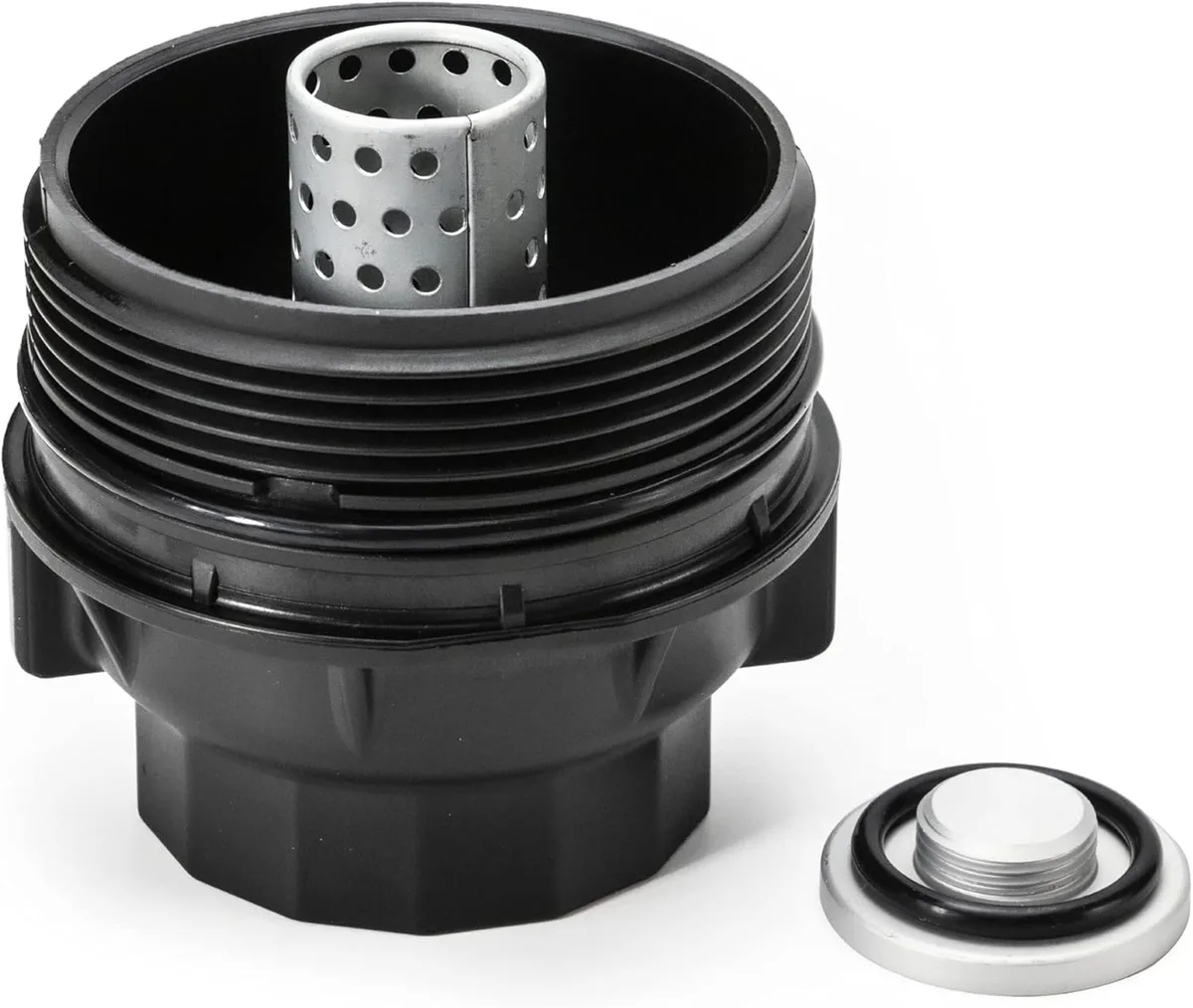
Image source: Web (Bing) / amazon.com.au (Web image (fair-use with source credit))
Common Mistakes Owners Make
We have seen the same errors pop up again and again in owner forums and service records.
Overfilling. Adding too much oil causes the crankshaft to whip the oil into foam. Aerated oil doesn't lubricate properly. You can damage bearings and hydraulically lock the engine.
Fill to the full mark, never above.
Ignoring the oil cap sticker. Some newer Highlanders have a sticker on the oil cap that says "0W-16 ONLY." That is not a suggestion. If the cap says 0W-16, do not put anything else in there.
Using the wrong filter. Aftermarket filters sometimes have different bypass valve pressures than OEM. That can affect oil flow at startup. Stick with Toyota or Aisin filters, or a high-quality aftermarket brand like Wix or Mann.
Neglecting the torque spec. The drain plug on the Highlander's aluminum oil pan strips easily. The spec is 29 ft-lbs for most models. Use a torque wrench.
Hand-tightening and then guessing is how oil pans get ruined.
Forgetting the turbo cool-down. If you have the turbo engine, let the engine idle for 30 to 60 seconds before shutting it off after hard driving. This keeps oil flowing through the turbo bearings as they cool down. Modern turbos have some protection, but it's a good habit.
When to Stray From the Owner's Manual
The owner's manual is your primary source. But there are situations where you might adjust your approach.
High-Mileage Highlanders
For Highlanders over 75,000 miles, some owners switch to a high-mileage formulation. These oils have seal conditioners that can reduce minor oil leaks. They also have swelling agents that help older seals.
They have slightly higher detergency to clean deposits. They are safe to use as long as they meet the same viscosity and API certification as your standard oil.
Towing and Heavy Loads
If you regularly tow near the maximum capacity (5,000 pounds for the V6), your engine runs hotter and the oil sees higher loads. Consider using the factory-approved 5W-30 alternative if your manual allows it. More importantly, shorten your oil change interval to 5,000 miles or 6 months.
Heat breaks down oil faster, regardless of viscosity.
Extreme Climate Driving
In extreme cold (below -20°F), 0W-16 and 0W-20 are both excellent choices. The 0W cold rating ensures flow at very low temperatures. In extreme heat (above 100°F for extended periods), stick with the recommended viscosity.
Modern synthetics handle high temperatures well. Only switch to 5W-30 if your manual explicitly allows it for sustained high-speed driving in extreme heat.
How Often Should You Change It?
Toyota's standard oil change interval for the Highlander is 10,000 miles or 12 months under normal driving conditions. That is a maximum. Real-world conditions often warrant shorter intervals.
Check your driving against the "severe service" schedule in the owner's manual. Use the severe schedule (5,000 miles or 6 months) if any of these apply:
- Frequent short trips (under 5 miles) in cold weather
- Driving on dusty or rough roads
- Extensive idling or stop-and-go traffic
- Towing or carrying heavy loads
- Operating in extreme hot or cold temperatures
Most Highlander owners fall into the severe service category. Commuters who drive 20 miles each way in traffic? Severe.
Suburban drivers doing school runs and errands? Severe. Only long-distance highway drivers can safely stretch to 10,000 miles.
For the hybrid engine, some owners report oil dilution issues. Fuel gets into the oil, especially in colder climates. If you smell fuel on the dipstick, change the oil immediately.
Consider a 5,000-mile interval. The turbo engine also benefits from shorter intervals due to the higher thermal load on the oil.
Frequently Asked Questions
Can I use 5W-30 instead of 0W-20 in my Highlander?
Only if your specific owner's manual lists it as an alternative for extreme conditions. For the V6 engine, some manuals allow it for sustained high-speed driving in hot weather. For the hybrid, never use 5W-30.
Check your manual and stick with the recommended viscosity unless you have a clear factory-approved reason to switch.
How much oil does a Toyota Highlander take?
It depends on the engine. The 3.5L V6 takes about 5.7 quarts. The 2.5L hybrid takes about 4.4 quarts.
The 2.4L turbo takes about 5.2 quarts. Always check with the dipstick after filling. The exact capacity varies slightly between model years.
What happens if I accidentally put the wrong oil in my Highlander?
One mistake won't destroy your engine. Drain it and refill with the correct oil. If you run the wrong viscosity for thousands of miles, you risk increased wear, reduced fuel economy, and potential sludge buildup.
If it is a hybrid using 0W-20 instead of 0W-16, switch back at your next oil change.
Is synthetic oil required for the Toyota Highlander?
Yes, for most modern Highlander engines. The V6 and hybrid both require full synthetic to meet the viscosity and protection requirements. The turbo engine absolutely requires full synthetic due to the high temperatures the turbocharger produces.
Conventional oil will break down too quickly.
Does the oil type affect fuel economy in the Highlander?
Yes, significantly. Using the correct viscosity can improve fuel economy by 2 to 4 percent compared to a thicker oil. For the hybrid, using 0W-16 instead of 0W-20 can provide a measurable MPG improvement.
The difference is small on a single tank but adds up over the life of the vehicle.
Can I switch between synthetic and conventional oil?
You can, but you shouldn't. Once you use synthetic, stick with it. The additive packages are different, and mixing them dilutes the benefits.
More importantly, modern Highlander engines require full synthetic. Conventional oil does not provide adequate protection for the tight tolerances and high operating temperatures.
The Bottom Line: One Recommendation Per Engine
Here is your cheat sheet, no ambiguity.
V6 Highlander (3.5L, 2014, 2023): SAE 0W-20 full synthetic. API SP or SN Plus. Change every 5,000 to 7,500 miles for most drivers.
Hybrid Highlander (2.5L, 2020, present): SAE 0W-16 full synthetic. API SP or ILSAC GF-6B. Do not substitute.
Change every 5,000 miles if you do short trips. Up to 10,000 miles if mostly highway.
Turbo Highlander (2.4L, 2023, present): SAE 0W-20 full synthetic. API SP. Change every 5,000 miles to protect the turbocharger and prevent oil dilution.
Use a quality brand. Change it on time. Your Highlander will easily cross 200,000 miles.
Oil is cheap. Engines are not.