
Getting the wrong oil into your Toyota RAV4 is one of the fastest ways to shorten its engine life, and it happens more often than you'd think. The exact toyota rav4 engine oil type isn't a one-size-fits-all answer. It depends on your model year, engine generation, and whether you're driving a gas model or a hybrid.
Manufacturer specifications indicate that a mismatch of just one viscosity grade can reduce fuel economy by up to 2 percent. It also accelerates wear on critical components like the variable valve timing system. As of 2026, the vast majority of RAV4s on the road require 0W-20 full synthetic oil.
Some older models need 5W-30, and the newest hybrids call for an even lighter 0W-16.

Image source: Bing (Web (fair-use with source credit))
Quick Answer
Most Toyota RAV4s from 2011 onward take 0W-20 full synthetic oil. RAV4 Hybrid models from 2020 forward use 0W-16. Older RAV4s from 2006 to 2010 take 5W-30.
Always check your owner's manual first. The oil must carry API SP or SN Plus certification. Capacity is roughly 4.4 to 4.8 quarts depending on the engine.

Image source: Bing (Web (fair-use with source credit))
Why Getting the Right Oil for Your RAV4 Actually Matters
This isn't about brand loyalty. It's about engineering. Toyota designs its engines around specific oil properties.
Those properties affect everything from cold starts to timing chain life.
Modern RAV4 engines use variable valve timing, low-tension piston rings, and tight bearing clearances. These parts assume a particular oil viscosity and additive package. Pour in the wrong grade and components work in conditions they weren't built for.
Too thick and the oil won't flow fast enough at startup. Too thin and it can't maintain a protective film at operating temperature.
The stakes go beyond engine wear. Using oil that doesn't meet Toyota's specifications can void your warranty. Under the Magnuson-Moss Warranty Act, the manufacturer must prove the wrong oil caused the damage.
Fighting that battle costs time and money. Getting it right from the start is the only smart move.
Breaking Down the Engine Options
The RAV4 has used several different engines over its production life. Each one has unique oil requirements.
2.5L 4-Cylinder (2013 to Present)
This engine powers most RAV4s sold today. The 2AR-FE (2013-2018) and the newer A25A-FKS (2019 onward) both require 0W-20 full synthetic. The A25A-FKS benefits from API SP oil because it helps prevent low-speed pre-ignition.
3.5L V6 (2006 to 2012)
The 2GR-FE V6 was a smooth option in the RAV4. Toyota recommended 5W-30 for this engine in most climates. Some owners in extremely cold regions switch to 0W-20 without issues if the engine isn't burning oil.
2.0L and 2.4L Engines (1996 to 2005)
First and second generation RAV4s used either a 2.0L or 2.4L 4-cylinder. These older engines called for 5W-30 conventional oil. If you own one with over 100,000 miles, many mechanics recommend switching to a high-mileage 5W-30 formulation.
RAV4 Hybrid (2016 to Present)
The hybrid powertrain uses the 2.5L Atkinson-cycle engine. Early hybrids (2016-2019) take 0W-20. The 2020 and newer models with the updated hybrid system specify 0W-16 for maximum efficiency.
Using 0W-20 in a 2021 hybrid won't cause immediate damage, but it will drop your fuel economy slightly.
What the Viscosity Numbers Really Mean
The Society of Automotive Engineers sets the viscosity standard. It's simpler than it looks.
The first number with the "W" stands for winter viscosity. It measures cold flow. Lower numbers mean better cold weather performance.
A 0W oil flows more easily at -30°F than a 5W oil. That's why modern engines spec 0W.
The second number represents viscosity at 212°F, roughly engine operating temperature. A 20-grade oil is thinner than a 30-grade oil. Modern RAV4 engines with tight tolerances need the thinner 20-grade to circulate through narrow oil passages and reach variable valve timing components quickly.
The trade-off isn't about which is better in an absolute sense. It's about which matches your engine's design. Put 5W-30 in a 2023 RAV4 and the oil won't flow fast enough during cold starts.
Put 0W-20 in a 2008 V6 and it might be too thin for the bearing clearances.
Oil Certification: Why API and ILSAC Matter More Than the Brand
Brand loyalty is a trap in the oil aisle. What matters is whether the bottle carries the right API certification and ILSAC grade.

Image source: Web (Bing) / motoroilguide.com (Web image (fair-use with source credit))
The American Petroleum Institute runs a certification program. Look for the API donut symbol on the back of the bottle. Inside that donut, you'll see a service rating like SN, SN Plus, or SP.
For any RAV4 built after 2011, you need at least SN Plus. For 2019 and newer engines, API SP is the current standard.
ILSAC adds fuel economy requirements on top of API standards. The current ILSAC grade is GF-6, which replaced GF-5 in 2020. Toyota specifically recommends ILSAC-certified oils for all modern RAV4 engines.
A bottle that says "meets or exceeds API SP" without the actual donut symbol hasn't been certified. It's just a claim. Always buy oil that shows the physical certification mark.
How to Find Your Exact Oil Spec
You have three ways to find the exact oil specification for your RAV4.
Method One: The Owner's Manual
This is the definitive source. Toyota prints the oil viscosity, API rating, and capacity right in the manual. Look in the maintenance section or near the vehicle specifications pages.
Toyota makes PDF versions available on their owner's website.
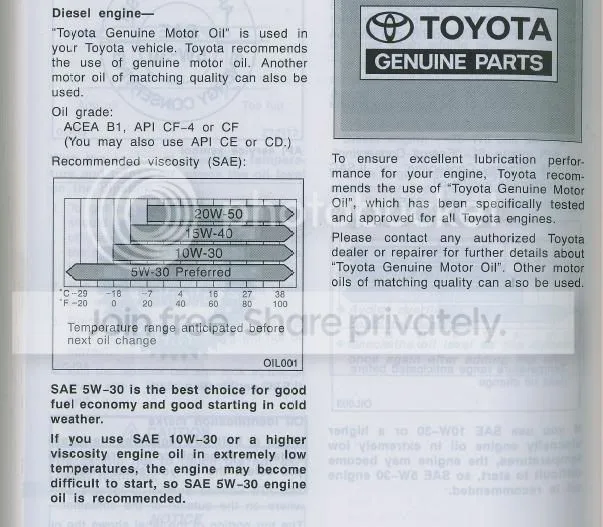
Image source: Bing (Web (fair-use with source credit))
Method Two: The Oil Fill Cap
Most RAV4s from 2011 onward have the oil viscosity printed directly on the oil fill cap. Pop the hood and check. If it says 0W-20, that's your spec.
This method is fast but doesn't tell you the required API rating or capacity.
Method Three: Your VIN
If you're unsure about the manual or the cap, your VIN is the ultimate backup. Call any Toyota dealership parts department and they can confirm the spec in under a minute. You can also find VIN-specific oil information on the official Toyota Owners website.
One caveat: if your RAV4 has over 100,000 miles, some mechanics recommend switching to a high-mileage formulation within the same viscosity grade. High-mileage oils contain seal conditioners that can reduce small leaks. But the viscosity grade itself should not change unless the manufacturer specifies otherwise.
The Real Cost Difference: Conventional vs. Synthetic vs. Blend
Price is the main reason people reach for conventional oil when their RAV4 needs synthetic. A five-quart jug of conventional 5W-30 runs about $15 to $20. The same amount of full synthetic 0W-20 costs $25 to $45.
| Oil Type | Typical Price (5 qt) | Change Interval | Cost Per 10,000 Miles |
|---|---|---|---|
| Conventional 5W-30 | $15 – $20 | 3,000 – 5,000 miles | $30 – $65 |
| Synthetic Blend | $20 – $30 | 5,000 – 7,500 miles | $27 – $60 |
| Full Synthetic 0W-20 | $25 – $45 | 10,000 miles | $25 – $45 |
Full synthetic comes out cheaper per mile because you change it less often. Synthetic oil resists breakdown at high temperatures, flows better in cold weather, and keeps engines cleaner. Those benefits translate to fewer repairs.
Synthetic blends mix conventional oil with a small amount of synthetic base stock. Toyota doesn't recommend them for modern RAV4s. Skip them unless you're driving an older model and want a slight upgrade.
The only scenario where conventional oil makes financial sense is a high-mileage older RAV4 that burns oil. If you're adding a quart every 500 miles, paying for synthetic gets expensive fast.
Oil Change Interval Truths: 5,000 vs. 10,000 Miles
Toyota says 10,000 miles or 12 months between oil changes for most RAV4s. That's printed in the manual. Many owners follow that schedule without issue.
But not everyone drives under normal conditions.
Toyota defines severe service as repeated short trips under 5 miles, extensive idling, dusty conditions, frequent stop-and-go traffic, towing, or extreme temperatures. If any of those describe your driving, the recommended interval drops to 5,000 miles.
Most RAV4 owners fall into the severe service category without realizing it. A daily commute of 15 miles in city traffic counts as severe service. So does living in a climate where winter temperatures stay below freezing for months.
A practical middle ground is 7,500 miles with full synthetic. It's not what Toyota specifies, but extended oil analysis studies support it for moderately severe driving.
Common Mistakes That Cost RAV4 Owners Real Money
Using the Wrong Viscosity
This is the number one error. A 2019 RAV4 owner pours in 5W-30 because that's what they used in their old truck. The engine runs but fuel economy drops.
Cold start wear increases. Over 50,000 miles, this mistake can shorten engine life.
Ignoring the API Rating
A bottle says 0W-20 but carries only API SN, not SN Plus or SP. In a 2020 engine, that oil doesn't protect against low-speed pre-ignition. Always check the donut symbol, not just the viscosity number.
Overfilling
Too much oil creates foam as the crankshaft churns through it. Foam doesn't lubricate properly. It can also blow out seals and gaskets.
Fill to the full mark on the dipstick and stop.
Using Cheap Oil Filters
The oil filter matters as much as the oil. A cheap filter with inadequate internal volume or a faulty bypass valve restricts oil flow. Toyota genuine filters or quality aftermarket options are worth the extra few dollars.
Ignoring the Reset
After an oil change, you need to reset the maintenance reminder. If you don't, the system continues counting miles from the old change. The reset takes 30 seconds and varies by model year.
High-Mileage RAV4s: When (and If) You Should Switch
A RAV4 with over 100,000 miles isn't old. These vehicles regularly reach 200,000 miles. But the oil needs change slightly.
High-mileage oil formulations contain seal conditioners that keep gaskets flexible. They also include higher levels of detergents and anti-wear additives. Switching to a high-mileage 0W-20 at 100,000 miles is smart for most RAV4s.
Use the same viscosity grade.
One exception: if your RAV4 has never used synthetic oil and you're at 100,000 miles on conventional, switching to full synthetic can cause leaks. Synthetic oil cleans deposits aggressively. If those deposits were plugging gaps in old seals, the cleaning effect can open those gaps.
Stick with conventional or switch gradually using a synthetic blend for the first few changes.
Hybrid Owners: The Oil That Keeps Your e-CVT Happy
Hybrid RAV4s have specific oil requirements. The engine is similar to the gas model, but the demands on the oil are different.
In a hybrid, the engine cycles on and off based on power demand. The oil never fully warms up during short trips. Condensation builds up in the crankcase.
Fuel dilution happens more easily.
Toyota specifies 0W-20 for 2016 to 2019 hybrid RAV4s and 0W-16 for 2020 and newer models. The 0W-16 grade reduces internal friction in the Atkinson-cycle engine. Using 0W-20 in a 2021 hybrid won't cause mechanical failure, but you'll lose about 1 to 2 miles per gallon.
The most important factor for hybrid owners is the change interval. Severe service intervals apply even more strongly to hybrids. If most trips are under 10 miles and the engine rarely reaches full operating temperature, change the oil every 5,000 miles.
Step-by-Step: Choosing the Right Oil for Your Climate and Driving
If you live in a cold climate where temperatures drop below freezing, stick with 0W-20 or 0W-16 for hybrids. The 0W rating ensures instant flow on cold starts. Never use 5W-30 in these conditions unless your older RAV4 specifically requires it.
If you live in a hot climate and tow frequently, the 0W-20 spec still applies for modern RAV4s. The oil's hot viscosity rating of 20 is what matters at operating temperature. Don't assume you need thicker oil because you live in Arizona.
If your daily drive is a 30 minute highway commute with no towing, the standard 10,000 mile interval on 0W-20 is safe. If you make short trips under 5 miles or drive in stop-and-go traffic, switch to the 5,000 mile interval regardless of which oil you choose.
When to Hit the Dealer vs. When to DIY
A dealer oil change costs between $60 and $90. Doing it yourself costs $30 to $50 for oil and a filter. The dealer includes a multipoint inspection and proper disposal.
DIY gives you control over exactly which oil and filter go in.
Choose the dealer if you're under warranty and want a documented service history. Toyota's system records every dealer visit, which simplifies warranty claims. Choose DIY if you're comfortable with basic tools and want to save money.
The job takes about 30 minutes.
One note on quick-lube shops. Many use bulk oil from unknown sources. They might not stock the correct viscosity for your specific RAV4.
They also tend to overfill. If you use a quick-lube chain, specify the exact oil grade and bring your own filter if possible.
Final Verdict
For a 2011 or newer Toyota RAV4, use 0W-20 full synthetic oil carrying API SP or SN Plus certification. For a 2020 or newer hybrid, use 0W-16 with the same certification. For a 2006 to 2010 model, use 5W-30 conventional or high-mileage oil if over 100,000 miles.
Change it every 10,000 miles for highway driving. Change it every 5,000 miles for severe service conditions. Use a quality filter.
Reset the maintenance light. And when in doubt, check the owner's manual or your VIN.
One quart of the wrong oil won't destroy your engine. But 50,000 miles on the wrong oil absolutely will. Make the right choice.
Frequently Asked Questions
Can I use 5W-30 instead of 0W-20 in my RAV4?
Not recommended unless your owner's manual specifically lists both grades. Modern RAV4 engines are designed for 0W-20's cold flow properties. Using 5W-30 increases cold start wear and reduces fuel economy.
How often should I change the oil in my RAV4 hybrid?
Follow the severe service interval of every 5,000 miles if you take short trips. The engine cycles on and off in hybrids, keeping oil temperatures lower. This causes condensation and fuel dilution to accumulate faster than in a gas-only RAV4.
What happens if I put conventional oil in a RAV4 that needs synthetic?
The engine will run, but you risk sludge buildup over time. Conventional oil breaks down faster at high temperatures. Toyota's warranty requires synthetic in engines that specify it.
Does the brand of oil matter for my RAV4?
Not as much as the certification. Any oil carrying the correct API and ILSAC certification in the right viscosity works fine. Toyota Genuine Motor Oil, Mobil 1, Pennzoil Platinum, and Valvoline Advanced are reliable options.
Can I switch back and forth between oil brands?
Yes. Brand switching has no negative effects as long as the oil meets the correct viscosity and certification standards. Don't switch viscosity grades or API ratings between changes.